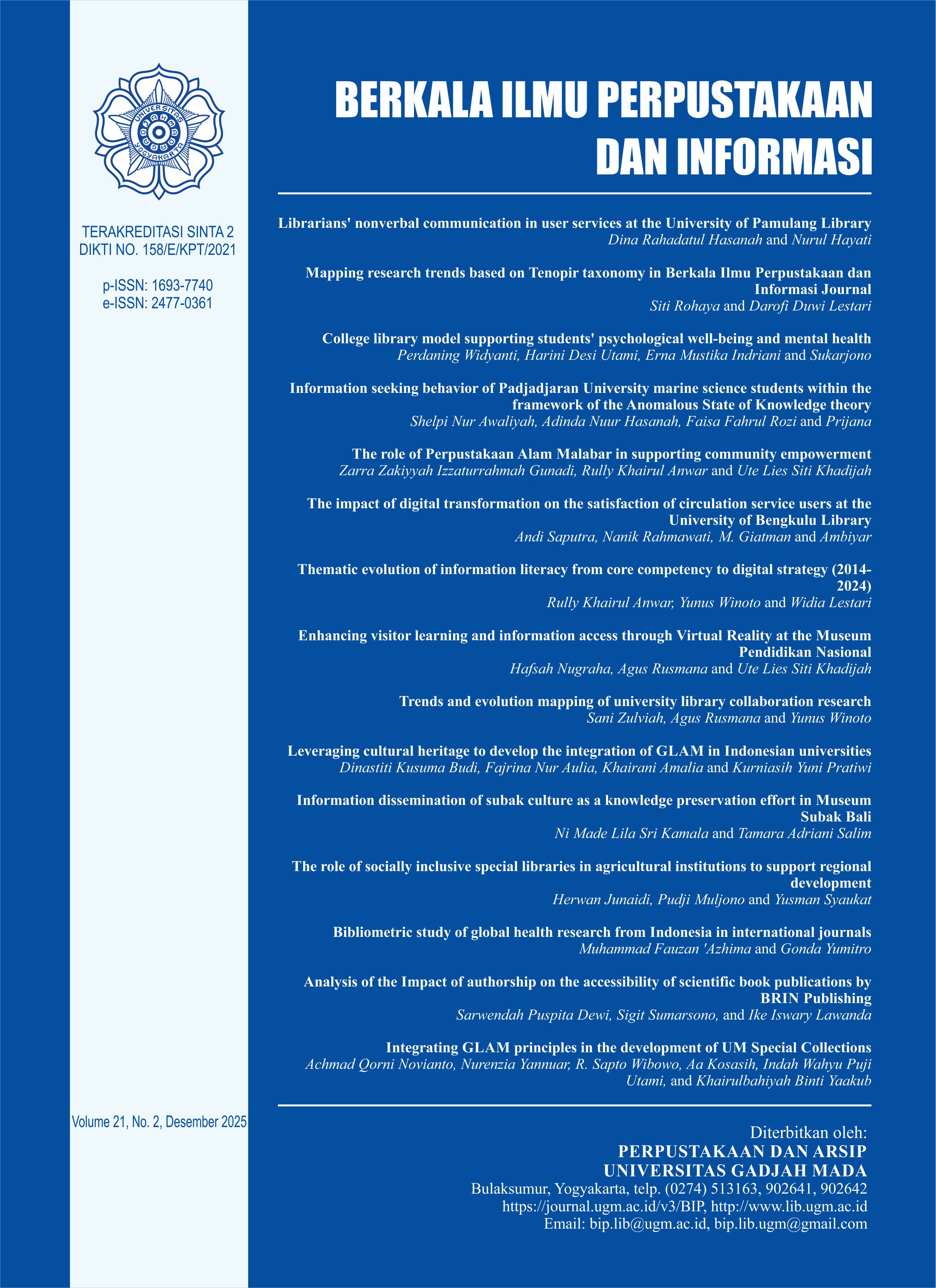
Information seeking behavior of Padjadjaran University marine science students within the framework of the Anomalous State of Knowledge theory
Abstract
Introduction. The information seeking behavior of Marine Science students is important in broadening understanding of a multidisciplinary field and is prone to triggering knowledge gaps. Anomalous State of Knowledge (ASK) theory is relevant to explain these conditions, because it views information seeking as a response to anomalies in individual knowledge structures. This study aims to identify whether the information seeking behavior of Marine Science students is dynamic, with the formulation of the problem: whether studying topics relevant to marine microbiology is significantly associated with interest in seeking information outside the field.
Research Methods. This research method uses survey method, with a simple random sampling method.
Data Analysis. Data were analyzed using the Pearson product-moment correlation test using SPSS software.
Results. The results showed a significant relationship between engagement in marine microbiology topics and interest in cross-disciplinary information exploration, reflecting an active response to knowledge anomalies. Students not only filled information gaps but also developed broad and adaptive search strategies.
Conclusion. This research shows that Marine Science students' information-seeking behavior is dynamic and aligned with the ASK principle, so this approach is important for understanding and developing academic information systems responsive to evolving information needs.
References
Aeni, L. N., Indah, R. N., & Syam, R. Z. A. (2021). Perilaku pencarian informasi goldenness. N-JILS: Nusantara Journal of Information and Library Studies, 4(1), 17–30. https://doi.org/https://doi.org/10.30999/n-jils.v4i1.1193.
Alhusna, F. N., & Masruroh, S. (2021). Model perilaku pencarian informasi dalam memenuhi kebutuhan informasi. IJAL: Indonesian Journal of Academic Librarianship, 5(1), 19–28.
Belkin, N. J. (1980). Anomalous states of knowledge as a basis for information retrieval. Canadian Journal of Information Science, 5, 133–143.
Dustiarana, R., & Sofyan, A. (2020). Hubungan antara pencarian informasi dengan pemenuhan kebutuhan informasi mahasiswa. Prosiding Manajemen Komunikasi, 6(1), 117–120. https://doi.org/http://dx.doi.org/10.29313/.v0i0.20620.
Fakhriyah, A. (2020). Perilaku pencarian informasi kesehatan ibu rumah tangga di kelurahan Kelapa Dua Wetan [UIN Syarif Hidayatullah Jakarta]. https://repository.uinjkt.ac.id/dspace/handle/123456789/51242.
Harter, S. P. (1992). Psychological relevance and information science. Journal of the American Society for Information Science, 43(9), 602–615. https://doi.org/10.1002/(SICI)1097-4571(199210)43:9<602::AID-ASI3>3.0.CO;2-Q.
Huang, Y., & Yang, C. (2020). A metacognitive approach to reconsidering risk perceptions and uncertainty: Understand information seeking during COVID-19. Science Communication, 42(5), 616–642. https://doi.org/10.1177/1075547020959818.
Kasim, N. A. (2009). Evaluating users satisfaction on academic library performance. Journal of Library & Information Science, 14(2), 101–115.
Kuhlthau, C. C. (1991). Inside the search process: Information seeking from the user’s perspective. Journal of the American Society for Information Science, 5(42), 361–371.
Maha, R. N. (2019). Kebutuhan informasi dan perilaku pencarian informasi peneliti pusat penelitian biomaterial LIPI. Jurnal Acarya Pustaka, 6(1), 53–65. https://doi.org/https://doi.org/10.23887/ap.v6i1.22183.
Masinde, J. M., Wambiri, D. M., & Chen, J. (2020). Gender and cognitive factors influencing information seeking of graduate students at Kenyatta University Library. South African Journal of Information Management, 22(1), 1–10. https://doi.org/10.4102/sajim.v22i1.1154.
Nurfadillah, M., & Ardiansah, A. (2021). Perilaku pencarian informasi mahasiswa dalam memenuhi kebutuhan informasi sebelum dan saat pandemi Covid-19. Fihris: Jurnal Ilmu Perpustakaan Dan Informasi, 16(1), 21–39. https://doi.org/10.14421/fhrs.2021.162.21-39.
Ogo, E. P., & Uchendu, B. O. (2024). Informationn needs and seeking behaviour of final year students of a specialized University in Nigeria. Information Impact: Journal of Information and Knowledge Management, 15(1), 129–142. https://doi.org/10.4314/iijikm.v15i1.10.
Prijana, P., & Yanto, A. (2020). Metode penelitian perpustakaan dan sains informasi. Simbiosa Rekatama Media.
Prijana, P., & Yanto, A. (2022). Metode sampling peluang. Pustaka Utama Bandung.
Ramadhan, A. N., & Irhandayaningsih, A. (2023). Perilaku pencarian informasi Mmhasiswa Universitas Islam Nahdlatul Ulama Jepara terkait skripsi. Anuva: Jurnal Kajian Budaya, Perpustakaan, Dan Informasi, 7(1), 54–62. https://doi.org/10.14710/anuva.7.1.54-62.
Rodiah, S., Ariani, A. K., Nazar, M. A., & Tyas, Z. W. (2024). Hubungan kebutuhan informasi dengan perilaku pencarian informasi pada website Kandaga Universitas Padjadjaran. Lentera Pustaka: Jurnal Kajian Ilmu Perpustakaan, Informasi Dan Kearsipan, 10(1), 21–32. https://doi.org/10.14710/lenpust.v10i1.54732.
Rohmiyati, Y. (2018). Model perilaku pencarian informasi generasi milenial. Anuva: Jurnal Kajian Budaya, Perpustakaan, Dan Informasi, 2(4), 387–392. https://doi.org/10.14710/anuva.2.4.387-392.
Savolainen, R. (2017). Information need as trigger and driver of information seeking: a conceptual analysis. Aslib Journal of Information Management, 69(1), 2–21. https://doi.org/10.1108/AJIM-08-2016-0139.
Silalahi, R., Wahhaj, I. S., Prijana, P., & Rukmana, E. N. (2024). Model pencarian informasi mahasiswa teknik geologi Universitas Padjadjaran: Sebuah kajian teori ASK (Anomolous State of Knowledge). Palimpsest: Jurnal Ilmu Informasi Dan Perpustakaan, 15(2), 131–149. https://doi.org/10.20473/pjil.v15i2.64033.
Siregar, S. (2017). Metode penelitian kuantitatif (1st ed., Vol. 4). Kencana.
Siyoto, S., & Sodik, M. A. (2015). Dasar metodologi penelitian (1st ed., Vol. 1). Literasi Media Publishing.
Subaveerapandiyan, A., Vijay Kumar, R., & Prabhu, S. (2025). Marine information-seeking behaviours and AI chatbot impact on information discovery. Information Discovery and Delivery, 53(2), 206–216. https://doi.org/10.1108/IDD-10-2023-0119.
Sugiyono, S. (2019). Metode penelitian kuantitatif, kualitatif, dan R&D (2nd ed., Vol. 1). Alfabeta.
Widiyastuti, W. (2016). Perbandingan teori perilaku pencarian informasi menurut Ellis, Wilson, dan Kuhlthau. Jurnal Pustaka Budaya, 3(2), 51–64.
Wilson, T. D. (2000). Human information behavior. Informing Science: The International Journal of an Emerging Transdiscipline, 3(2), 49–56. https://doi.org/10.28945/576.
Yadav, A. K. S., & Singh, P. K. (2016). Information needs and information-seeking behaviour of post-graduate and doctoral students. Library Progress (International), 36(2), 153–165. https://doi.org/10.5958/2320-317X.2016.00013.1.
Copyright (c) 2025 Berkala Ilmu Perpustakaan dan Informasi

This work is licensed under a Creative Commons Attribution-ShareAlike 4.0 International License.

Berkala Ilmu Perpustakaan dan Informasi is licensed under a Creative Commons Attribution-ShareAlike 4.0 International License.
- Articles published in Berkala Ilmu Perpustakaan dan Informasi are licensed under a Creative Commons Attribution-ShareAlike 4.0 International license. You are free to copy, transform, or redistribute articles for any lawful purpose in any medium, provided you give appropriate credit to the original author(s) and Berkala Ilmu Perpustakaan dan Informasi, link to the license, indicate if changes were made, and redistribute any derivative work under the same license.
- Copyright on articles is retained by the respective author(s), without restrictions. A non-exclusive license is granted to Berkala Ilmu Perpustakaan dan Informasi to publish the article and identify itself as its original publisher, along with the commercial right to include the article in a hardcopy issue for sale to libraries and individuals.
- By publishing in Berkala Ilmu Perpustakaan dan Informasi, authors grant any third party the right to use their article to the extent provided by the Creative Commons Attribution-ShareAlike 4.0 International license.


