






- Focus and Scope
- Section Policies
- Peer Review Process
- Publication Frequency
- Open Access Policy
- Archiving
- Screening Plagiarism
- Publication Ethics
Focus and Scope
The Focus and Scope of Agro Ekonomi are designed to address key scholarly and policy-relevant issues in agricultural economics and agribusiness systems, with a particular emphasis on food and agricultural policy, rural development, and sustainable natural resource management. These thematic areas reflect major global challenges related to food security, agricultural transformation, environmental sustainability, and rural livelihoods, which are central to contemporary international research agendas. The journal’s scope is intentionally structured to integrate interdisciplinary analysis while maintaining a clear disciplinary core in agricultural socio-economics.
Furthermore, the journal emphasizes studies conducted in developing and emerging economies, where issues of agricultural productivity, value chain integration, resource governance, and rural development are particularly salient. This focus strengthens the journal’s international relevance and distinct positioning within the global landscape of agricultural economics journals.
The defined scope is sufficiently focused to ensure thematic consistency and citation coherence, while remaining broad enough to accommodate emerging research trends and interdisciplinary approaches aligned with the journal’s niche. As such, the Focus and Scope support the journal’s long-term strategy to enhance visibility, scholarly impact, and citation performance within the international reputable database.
1. Agricultural and Food Economics:
a) agricultural production;
b) farm management studies; and
c) food systems, food security, and nutrition economics
2. Food and Agricultural Policy:
a) formulation, implementation, and evaluation of agricultural and food policies; and
b) agricultural international trade.
3. Agribusiness and Value Chain Systems:
a) agribusiness management & entrepreneurial development;
b) agricultural marketing and market performance; and
c) governance and upgrading of agrifood supply and value chains
4. Agricultural Natural Resource and Environmental Economics:
a) economic analysis of land, water, and natural resource use for agriculture; and
b) climate change, environmental policy, and sustainable agriculture
5. Rural and Agricultural Development:
a) rural and agricultural development policies;
b) agricultural cooperatives and organizations; and c) community-based agribusiness and inclusive rural development
6. Agricultural Extension, Communication, and Institutions:
a) agricultural extension and innovation;
b) communication for agricultural and rural development; and
c) institutional change and socio-economic transformation in agriculture
Section Policies
Articles
 Open Submissions Open Submissions |
Indexed |
Peer Reviewed |
Special Issue
Editors- agus nugroho
| Open Submissions |
Indexed |
Peer Reviewed |
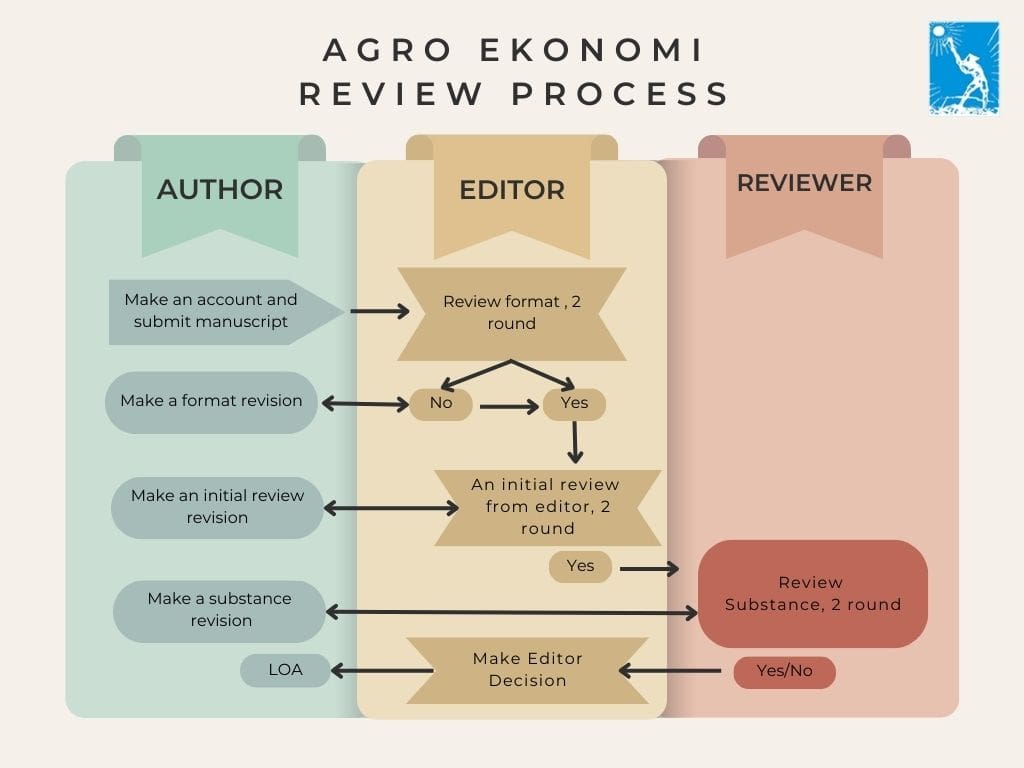
Peer Review Process
1. Initial Editorial Screening
All submitted manuscripts are first screened by the Editor-in-Chief to assess their conformity with the journal’s aims and scope, originality, academic quality, methodological rigor, ethical compliance, and international relevance. Manuscripts that do not meet these criteria or fail to comply with the journal’s submission requirements may be rejected at this stage without external review. (Indicative duration: up to 2 weeks)
2. Double-Blind Peer Review
Manuscripts that pass the initial screening are assigned to a Handling Editor and undergo a double-blind peer review process. Each manuscript is reviewed by at least two independent reviewers with relevant expertise and a proven publication record. Reviewers are selected based on their scholarly competence and institutional independence and are required to declare the absence of any potential conflicts of interest. Reviewers evaluate manuscripts based on originality, theoretical and methodological soundness, clarity of presentation, adequacy of references, and contribution to the field. (Indicative duration: up to 3 weeks)
3. First Editorial Decision
Based on the reviewers’ reports and editorial assessment, the Handling Editor may issue one of the following decisions:
✅Accepted without revision
✅Minor Revision
✅Major Revision
✅Rejected
✅Resubmission (when substantial revisions are required) Manuscripts recommended for resubmission may be treated as a new submission or proceed to a subsequent review round, depending on the extent of revisions.
4. Revision Stage
Authors are required to revise their manuscripts in accordance with reviewers’ comments and provide a detailed response to each point raised. The Handling Editor evaluates the adequacy and completeness of the revisions. If necessary, the revised manuscript may be sent back to the original or additional reviewers for further assessment. (Indicative duration for author revision: up to 2 weeks)
Publication Frequency
Journal Agro Ekonomi published regularly twice a year (June and December). The number of articles published per issue is 5-10 papers.
Open Access Policy
This journal provides immediate open access to its content on the principle that making research freely available to the public supports a greater global exchange of knowledge.
Archiving
This journal utilizes the LOCKSS system to create a distributed archiving system among participating libraries and permits those libraries to create permanent archives of the journal for purposes of preservation and restoration. More...
Screening Plagiarism
The manuscript that submitted into this journal will be screened for plagiarism using Turnitin.
Publication Ethics
Publication Ethics
PUBLICATION ETHICS
This statement clarifies the ethical behavior of all parties involved in the act of publishing an article in Agro Ekonomi, including the editors, the peer-reviewers, and the authors.
The publication of an article in Agro Ekonomi is support and embody the scientific method. It is therefore important to agree upon standards of expected ethical behavior for all parties involved in the act of publishing: the journal editors, the peer reviewers, the authors, the publisher and the society. AE is referring to Committee on Publication Ethics (COPE)
Agro Ekonomi takes its duties of guardianship all stages of the publishing process and we recognize our ethical and other responsibilities. We are committed to ensuring that advertising, reprint or other commercial revenue has no impact or influence on editorial decisions.
Duties of Authors
- Reporting Standards:
Authors of reports of original research should present an accurate account of the work performed as well as an objective discussion of its significance. Underlying data should be represented accurately in the paper. A paper should contain sufficient detail and references to permit others to replicate the work. Fraudulent or knowingly inaccurate statements constitute unethical behaviour and are unacceptable. - Data Access and Retention:
Authors are asked to provide the raw data in connection with a paper for editorial review, and should be prepared to provide public access to such data (consistent with the ALPSP-STM Statement on Data and Databases), if practicable, and should in any event be prepared to retain such data for a reasonable time after publication. - Originality and Plagiarism: The authors should ensure that they have written entirely original works, and if the authors have used the work and/or words of others that this has been appropriately cited or quoted.
- Multiple, Redundant or Concurrent Publication:
An author should not, in general, publish manuscripts describing essentially the same research in more than one journal or primary publication. Submitting the same manuscript to more than one journal concurrently constitutes unethical publishing behaviour and is unacceptable. - Acknowledgement of Sources:
Proper acknowledgement of the work of others must always be given. Authors should cite publications that have been influential in determining the nature of the reported work. - Authorship of the Paper:
Authorship should be limited to those who have made a significant contribution to the conception, design, execution, or interpretation of the reported study. All those who have made significant contributions should be listed as co-authors. Where there are others who have participated in certain substantive aspects of the research project, they should be acknowledged or listed as contributors. The corresponding author should ensure that all appropriate co-authors and no inappropriate co-authors are included on the paper and that all co-authors have seen and approved the final version of the paper and have agreed to its submission for publication. - Disclosure and Conflicts of Interest:
All authors should disclose in their manuscript any financial or another substantive conflict of interest that might be construed to influence the results or interpretation of their manuscript. All sources of financial support for the project should be disclosed. - Fundamental errors in published works:
When an author discovers a significant error or inaccuracy in his/her own published work, it is the author’s obligation to promptly notify the journal editor or publisher and cooperate with the editor to retract or correct the paper. - Hazards and Human or Animal Subjects:
If the work involves chemicals, procedures or equipment that have any unusual hazards inherent in their use, the author must clearly identify these in the manuscript.
Duties of Editors
- Fair Play:
An editor at any time evaluate manuscripts for their intellectual content without regard to race, gender, sexual orientation, religious belief, ethnic origin, citizenship, or political philosophy of the authors. - Confidentiality:
The editor and any editorial staff must not disclose any information about a submitted manuscript to anyone other than the corresponding author, reviewers, potential reviewers, other editorial advisers, and the publisher, as appropriate. - Disclosure and Conflicts of Interest:
Unpublished materials disclosed in a submitted manuscript must not be used in an editor's own research without the express written consent of the author. - Publication Decisions:
The editor board journal is responsible for deciding which of the articles submitted to the journal should be published. The validation of the work in question and its importance to researchers and readers must always drive such decisions. The editors may be guided by the policies of the journal's editorial board and constrained by such legal requirements as shall then be in force regarding libel, copyright infringement and plagiarism. The editors may confer with other editors or reviewers in making this decision. - Review of Manuscripts:
The editor must ensure that each manuscript is initially evaluated by the editor for originality. The editor should organise and use peer review fairly and wisely. Editors should explain their peer review processes in the information for authors and also indicate which parts of the journal are peer reviewed. The editor should use appropriate peer reviewers for papers that are considered for publication by selecting people with sufficient expertise and avoiding those with conflicts of interest.
Duties of Reviewers
- Contribution to Editorial Decisions:
Peer review assists the editor in making editorial decisions and through the editorial communications with the author may also assist the author in improving the paper. - Promptness:
Any selected referee who feels unqualified to review the research reported in a manuscript or knows that its prompt review will be impossible should notify the editor and excuse himself from the review process - Standards of Objectivity:
Reviews should be conducted objectively. Personal criticism of the author is inappropriate. Referees should express their views clearly with supporting arguments. - Confidentiality:
Any manuscripts received for review must be treated as confidential documents. They must not be shown to or discussed with others except as authorised by the editor. - Disclosure and Conflict of Interest:
Privileged information or ideas obtained through peer review must be kept confidential and not used for personal advantage. Reviewers should not consider manuscripts in which they have conflicts of interest resulting from competitive, collaborative, or other relationships or connections with any of the authors, companies, or institutions connected to the papers. - Acknowledgement of Sources:
Reviewers should identify relevant published work that has not been cited by the authors. Any statement that an observation, derivation, or argument had been previously reported should be accompanied by the relevant citation. A reviewer should also call to the editor's attention any substantial similarity or overlap between the manuscript under consideration and any other published paper of which they have personal knowledge.
AGRO EKONOMI ISSN 0215-8787 (print) , ISSN 2541-1616 (online) indexed by :