


 * Corresponding Author


Enhancing Growth and Yield of Foxtail Millet Using Pearl Oyster Biofouling Fertilizer
 https://doi.org/10.22146/ipas.109488
 Jeanne Ivonne Nendissa(1*), Johan Riry(2), Jogeneis Patty(3), Martha Amba(4), Andi Adriani Wahditiya(5), Raudatul Janna Lating(6)
(1) Pattimura University
(2) Pattimura University
(3) Pattimura University
(4) Pattimura University
(5) Pattimura University
(6) Pattimura University
(*) Corresponding Author
Abstract
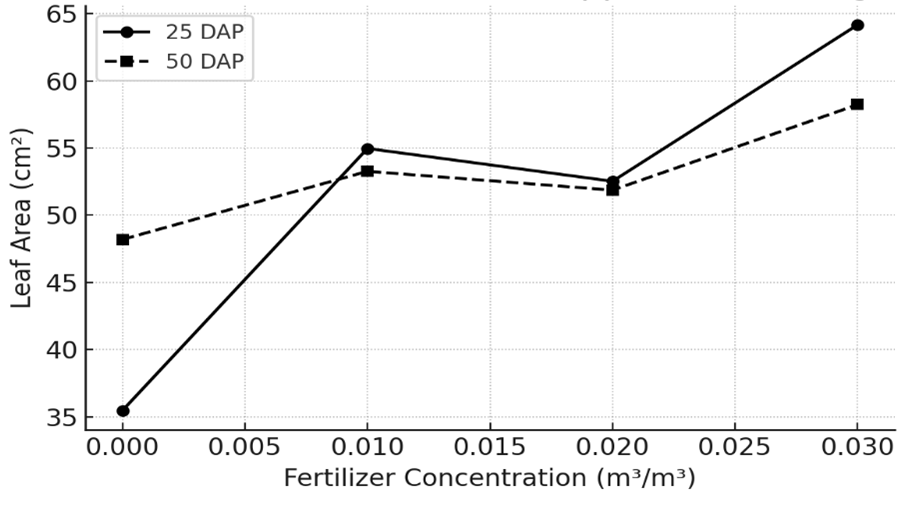
Hotong (Setaria italica L.), or foxtail millet, is an emerging alternative cereal crop with high adaptability to marginal environments and considerable nutritional value. This study aimed to evaluate the effects of liquid organic fertilizer (LOF) derived from pearl oyster (Pinctada maxima L.) biofouling waste on the growth and yield of hotong cultivated under tropical conditions in Mamala Village, Maluku. A factorial randomized block design was implemented using four fertilizer concentrations (0, 10, 20, and 30 mL·L⁻¹) and two application timings (25 and 50 days after planting, DAP). Results revealed that LOF application significantly enhanced both vegetative and reproductive traits. The concentration of 30 mL·L⁻¹ applied at 25 DAP produced the largest leaf area (64.17 cm²) and highest total biomass (306.91 g), indicating improved nutrient uptake and photosynthetic capacity during early growth. Yield components—including plant height, panicle number, and grain weight—increased by 40–60% relative to the control treatment. These findings demonstrate that organic fertilizer made from aquaculture biofouling waste functions as an effective nutrient source for cereal crops while contributing to environmentally responsible waste management. The integration of aquaculture residues into agricultural fertilizer production aligns with circular economy principles by promoting nutrient recycling, reducing reliance on synthetic fertilizers, and mitigating marine pollution associated with biofouling disposal. The implications of this research highlight the potential for scalable, low-cost, and eco-friendly fertilization strategies that enhance food security in marginal farming areas, strengthen coastal community resilience, and support sustainable linkages between aquaculture and terrestrial crop production systems.
Keywords
Full Text:
PDFReferences
Ali, S., Waqas, W., Bakky, M. A. H., Zada, S., Saif, U. M., Hasan, M. T., Shafiq, M., Dildar, T., & Hui, W. (2025). Implications of Microalgal–Bacterial Interactions in Modern Aquaculture Practices: A Review of the Current Knowledge. Reviews in Aquaculture, 17(1), e12980.
Alvarado-Ramírez, L., Santiesteban-Romero, B., Poss, G., Sosa-Hernández, J. E., Iqbal, H. M. N., Parra-Saldívar, R., Bonaccorso, A. D., & Melchor-Martínez, E. M. (2023). Sustainable production of biofuels and bioderivatives from aquaculture and marine waste. Frontiers in Chemical Engineering, 4, 1072761.
Anal, A. K., Singh, R., Rice, D., Pongtong, K., Hazarika, U., Trivedi, D., & Karki, S. (2024). Millets as supergrains: a holistic approach for sustainable and healthy food product development. Sustainable Food Technology, 2(4), 908–925.
Choudhary, P., Shukla, P., & Muthamilarasan, M. (2023). Genetic enhancement of climate-resilient traits in small millets: a review. Heliyon, 9(4).
Codreanu, S., Cepoi, L., Rudi, L., & Chiriac, T. (2025). Photosynthetic Microorganisms and Biogenic Synthesis of Nanomaterials for Sustainable Agriculture. Nanomaterials, 15(13), 990.
El Bilali, H., Strassner, C., & Ben Hassen, T. (2021). Sustainable agri-food systems: environment, economy, society, and policy. Sustainability, 13(11), 6260.
Firnia, D. (2018). Dinamika unsur fosfor pada tiap horison profil tanah masam. Jurnal Agroekoteknologi, 10(1).
Flo, V. Ø., Åsgård, T., & Lekang, O.-I. (2025). Phosphorus in Salmonid Aquaculture: Sources, Requirements, and System-Level Implications. Fishes, 10(8), 388.
Foley, J. A., Ramankutty, N., Brauman, K. A., Cassidy, E. S., Gerber, J. S., Johnston, M., Mueller, N. D., O’Connell, C., Ray, D. K., & West, P. C. (2011). Solutions for a cultivated planet. Nature, 478(7369), 337–342.
Legowo, D. L. R. A. M., & Dwiloka, B. (2015). Total bakteri asam laktat, pH, dan kadar laktosa yoghurt dengan penambahan tepung jewawut. Agromedia: Berkala Ilmiah Ilmu-Ilmu Pertanian, 33(2).
Melyana, M., Lesmana, R., & Valentina, R. (2023). Rekomendasi Pemupukan Jagung (Zea Mays L) di Desa Kelubir, Kabupaten Bulungan, Provinsi Kalimantan Utara. Jurnal Ilmu Pertanian Kaltara (JIPEK), 1(1), 14–20.
Nagaraja, T. E., Parveen, S. G., Aruna, C., Hariprasanna, K., Singh, S. P., Singh, A. K., Joshi, D. C., Joshi, P., Tomar, S. M. S., & Talukdar, A. (2024). Millets and pseudocereals: A treasure for climate resilient agriculture ensuring food and nutrition security. Indian Journal of Genetics and Plant Breeding, 84(01), 1–37.
Nendissa, J. I., Makaruku, M. H., Tanasale, V. L., Kilkoda, A. K., & Taribuka, J. (2021). Analysis of macro nutrient content in biofouling waste organic fertilizer pearl oyster (Pinctada maxima L.). IOP Conference Series: Earth and Environmental Science, 883(1), 012038.
Nendissa, J. I., Riry, J., Amba, M., & Soplanit, R. (2023). The Effect of Pearl Oyster (Pinctada maxima L.) Biofouling Waste Organic Fertilizer and Watering Interval on The Growth and Results of Mustard Greens (Brassica juncea L.). International Journal of Multidisciplinary: Applied Business and Education Research, 4(6), 1786–1795.
Saliu, T. D., & Oladoja, N. A. (2021). Nutrient recovery from wastewater and reuse in agriculture: a review. Environmental Chemistry Letters, 19(3), 2299–2316.
Schroth, G., & Sinclair, F. L. (2003). Trees, crops, and soil fertility: concepts and research methods. Cabi.
Shi, C., Qiu, T., Zhang, Y., Ma, Y., Li, X., Dong, S., Yuan, X., & Song, X. (2024). Effects of different preceding crops on soil nutrients and foxtail millet productivity and quality. Frontiers in Plant Science, 15, 1477756.
Tomasoa, R. S., Patty, J. R., & Nendissa, J. I. (2022). Pengaruh Pupuk Organik Cair Top G2 Dan Frekuensi Waktu Pemberian Terhadap Pertumbuhan Dan Hasil Hotong (Setaria italica L.).
Wang, Y., Wang, J., Dong, E., Liu, Q., Wang, L., Chen, E., Jiao, X., & Diao, X. (2023). Foxtail millet (Setaria italica L.) P. Beauv.] grown under nitrogen deficiency exhibits a lower folate contents. Frontiers in Nutrition, 10, 1035739.
Yuliani, S. S., Useng, D., & Achmad, M. (2017). Analisis kandungan nitrogen tanah sawah menggunakan spektrometer. Jurnal Agritechno, 188–202.
DOI: https://doi.org/10.22146/ipas.109488
Article Metrics
 Abstract views : 167
|
Abstract views : 167
|  views : 68
Refbacks
- There are currently no refbacks.


_2025_-_kecil_.png)
_2024_kecil_2.png)
Upcoming Issues :
-

Ilmu Pertanian (Agricultural Science) ISSN 0126-4214 (print), ISSN 2527-7162 (online) is published by Faculty of Agriculture Universitas Gadjah Mada collaboration with Perhimpunan Sarjana Pertanian Indonesia (PISPI) and licensed under a Creative Commons Attribution-ShareAlike 4.0 International License.