Issue
Date Log

This work is licensed under a Creative Commons Attribution-ShareAlike 4.0 International License.
Copyright
Upon acceptance of an article, authors transfer copyright to the JIEB as part of a journal publishing agreement, but authors still have the right to share their article for personal use, internal institutional use, and for any use permitted under the CC BY-SA license
Open Access
Articles are freely available to the public without any subscription with permitted reuse. For open access articles, permitted third party (re)use is defined by the following Creative Commons user licenses: Creative Commons Attribution (CC BY-SA).
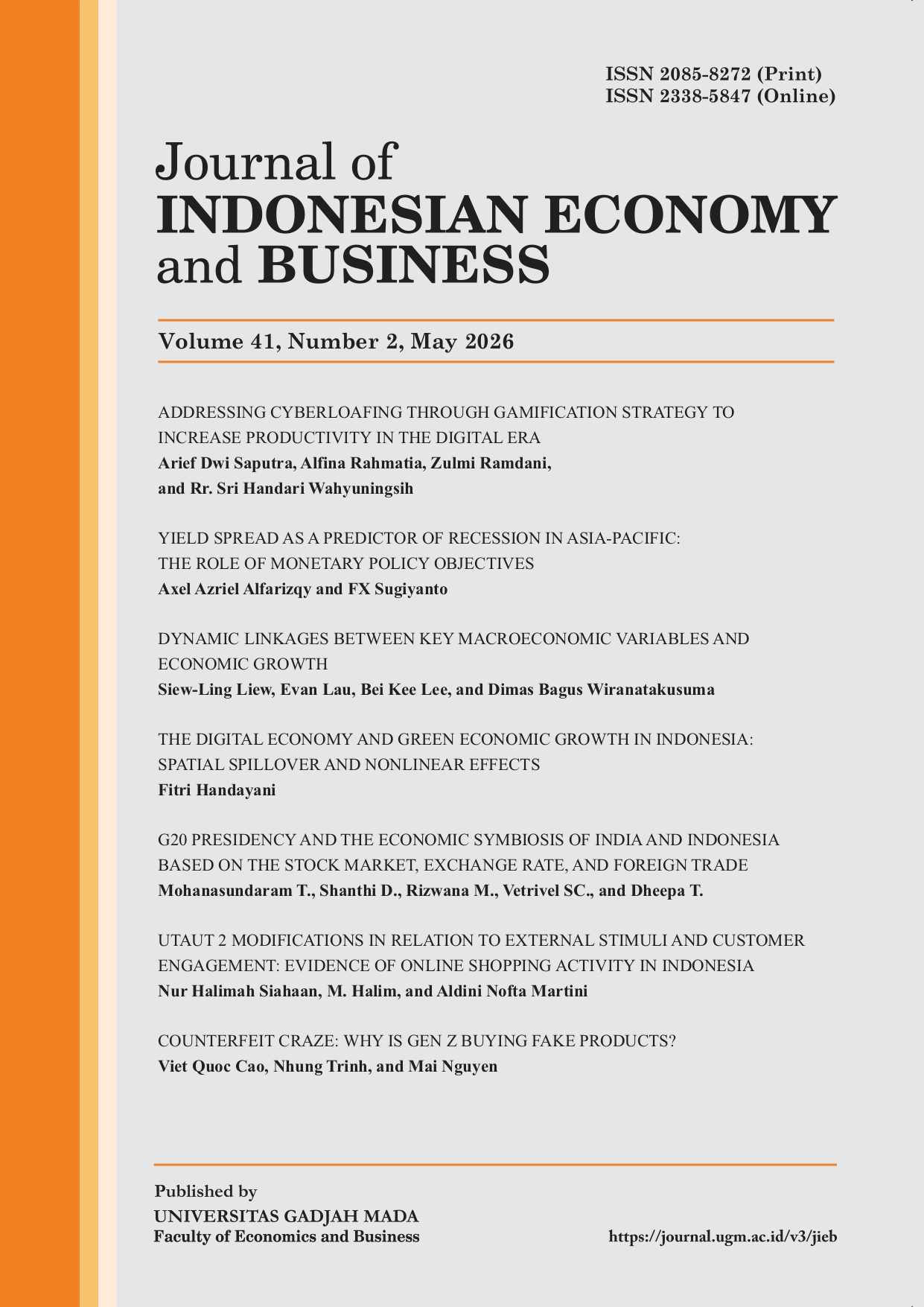
UTAUT 2 Modifications in Relation to External Stimuli and Customer Engagement: Evidence of Online Shopping Activity in Indonesia
Corresponding Author(s) : Aldini Nofta Martini
Journal of Indonesian Economy and Business,
Vol 41 No 2 (2026): May
Abstract
Introduction/Main Objectives: This study examines external stimuli and customer engagement within a modified Unified Theory of Acceptance and Use of Technology 2 (UTAUT2) framework. Background Problems: During the pandemic, online shopping applications gained rapid popularity, signaling the maturation of e-commerce as a retail channel and causing substantial shifts in consumer purchasing patterns. This study provides empirical evidence that UTAUT2 can explain how technological features influence customer engagement and, in turn, stimulate impulsive buying behavior. Novelty: This study extends UTAUT2 by analyzing how external stimuli and customer engagement interact to explain impulsive purchasing in online shopping applications, particularly in the context of a developing economy. Research Methods: Data were collected through a web-based survey of 246 active online shoppers. Hypotheses were tested using structural equation modeling (SEM). Finding/Results: The results show that external stimuli significantly affect customer engagement, which subsequently drives impulsive purchasing. Customer engagement acts as a mediating mechanism that links technological features with consumer behavior. Conclusion: This study advances the theoretical development of UTAUT2 by proposing a customer engagement model that explains impulsive buying in e-commerce. The findings also provide practical insights into online platforms on how to design features that enhance engagement and strategically encourage impulsive purchases.
Keywords
Download Citation
Endnote/Zotero/Mendeley (RIS)BibTeX
- Abdillah, W. (2009). The Effects Dispositional and Situational Cognitive Factors on The Intention to Use Internet: An Empirical Study of The Acceptance Of Information Technology at Universitas Bengkulu. Journal of Indonesian Economy and Business, 24(2), 177–204. https://doi.org/https://doi.org/10.22146/jieb.6323
- Abou-Shouk, M., & Soliman, M. (2021). The impact of gamification adoption intention on brand awareness and loyalty in tourism: The mediating effect of customer engagement. Journal of Destination Marketing and Management, 20. https://doi.org/10.1016/j.jdmm.2021.100559
- Aguinis, H., Hill, N. S., & Bailey, J. R. (2021). Best Practices in Data Collection and Preparation: Recommendations for Reviewers, Editors, and Authors. Organizational Research Methods, 24(4), 678–693. https://doi.org/10.1177/1094428119836485
- Ahn, J., & Back, K.-J. (2018). Antecedents and consequences of customer brand engagement in integrated resorts. International Journal of Hospitality Management, 75, 144–152. https://doi.org/10.1016/j.ijhm.2018.05.020
- Alalwan, A. A., Dwivedi, Y. K., & Rana, N. P. (2017). Factors influencing adoption of mobile banking by Jordanian bank customers: Extending UTAUT2 with trust. International Journal of Information Management, 37(3), 99–110. https://doi.org/10.1016/j.ijinfomgt.2017.01.002
- Aragoncillo, L., & Orús, C. (2018). Impulse buying behaviour: An online-offline comparative and the impact of social media. Spanish Journal of Marketing - ESIC, 22(1), 42–62. https://doi.org/10.1108/SJME-03-2018-007
- Ayub, R., & Zafar Maira. (2018). External Stimuli and Impulsive Buying Behavior. Market Forces College of Management Sciences, (1).
- Bank Indonesia. (2021). Laporan Perekonomian Indonesia Tahun 2021.
- Bellman, S., Potter, R. F., Treleaven-Hassard, S., Robinson, J. A., & Varan, D. (2011). The Effectiveness of Branded Mobile Phone Apps. Journal of Interactive Marketing, 25(4), 191–200. https://doi.org/10.1016/j.intmar.2011.06.001
- Bilal Ahmad, M., Fawad Ali, H., Sabir Malik, M., Humayun, A. A., & Ahmad, S. (2019). Factors Affecting Impulsive Buying Behavior with Mediating role of Positive Mood: An Empirical Study. European Online Journal of Natural and Social Sciences, 8(1), 17–35. http://www.european-science.com
- Boateng, S. L. (2019). Online relationship marketing and customer loyalty: a signaling theory perspective. International Journal of Bank Marketing, 37(1), 226–240. https://doi.org/10.1108/IJBM-01-2018-0009
- Brislin, R. W. (1970). Back-Translation for Cross-Cultural Research. Journal of Cross-Cultural Psychology, 1, 185–216. https://doi.org/https://doi.org/10.1177/135910457000100301
- Brodie, R. J., Hollebeek, L. D., Jurić, B., & Ilić, A. (2011). Customer engagement: Concep¬tual domain, fundamental propositions, and implications for research. Journal of Service Research, 14(3), 252–271. https://doi.org/10.1177/1094670511411703
- Brodie, R. J., Ilic, A., Juric, B., & Hollebeek, L. (2013). Consumer engagement in a virtual brand community: An exploratory analysis. Journal of Business Research, 66(1), 105–114. https://doi.org/10.1016/j.jbusres.2011.07.029
- Calder, B. J., Malthouse, E. C., & Schaedel, U. (2009). An Experimental Study of the Relationship between Online Engagement and Advertising Effectiveness. Journal of Interactive Marketing, 23(4), 321–331. https://doi.org/10.1016/j.intmar.2009.07.002
- Carter, S., & Yeo, A. C. M. (2016). Students-as-customers’ satisfaction, predictive retention with marketing implications: The case of Malaysian higher education business students. International Journal of Educa¬tional Management, 30(5), 635–652. https://doi.org/10.1108/IJEM-09-2014-0129
- Chang, A. (2012). UTAUT and UTAUT 2: A Review and Agenda for Future Research. In Journal The WINNERS (Vol. 13, Number 2).
- Chan, T. K. H., Cheung, C. M. K., & Lee, Z. W. Y. (2017). The state of online impulse-buying research: A literature analysis. Information and Management, 54(2), 204–217. https://doi.org/10.1016/j.im.2016.06.001
- Chen, C., & Yao, M. Z. (2022). Strategic use of immersive media and narrative message in virtual marketing: Understanding the roles of telepresence and transportation. Psychology and Marketing, 39(3), 524–542. https://doi.org/10.1002/mar.21630
- Chevalier, S. (2024). Retail e-commerce sales worldwide from 2014 to 2027. Statista. https://www.statista.com/statistics/379046/worldwide-retail-e-commerce-sales/
- Chiu, C. M., Wang, E. T. G., Fang, Y. H., & Huang, H. Y. (2014). Understanding customers’ repeat purchase intentions in B2C e-commerce: The roles of utilitarian value, hedonic value and perceived risk. Information Systems Journal, 24(1), 85–114. https://doi.org/10.1111/j.1365-2575.2012.00407.x
- Chopdar, P. K., Paul, J., & Prodanova, J. (2022). Mobile shoppers’ response to Covid-19 phobia, pessimism and smartphone addiction: Does social influence matter? Technological Forecasting and Social Change, 174. https://doi.org/10.1016/j.techfore.2021.121249
- Chopdar, P. K., & Sivakumar, V. J. (2018). Understanding psychological contract violation and its consequences on mobile shopping applications use in a developing country context. Journal of Indian Business Research, 10(2), 208–231. https://doi.org/10.1108/JIBR-07-2017-0109
- Chou, Y.-H. D., Li, T.-Y. D., Ho, C.-T. B., Chou, Y.-H. D., Li, , T-Y D, & Ho, C.-T. B. (2018). Factors Influencing the Technology Adoption of Mobile Commerce in Taiwan By Using the Revised UTAUT Model. In Int. J. Mobile Communications (Vol. 16, Number 2).
- Csikszentmihalyi, M. (1990). FLOW: The Psychology of Optimal Experience.
- Csikszentmihaly, M. (1990). Flow: The Psychology of Optimal Experience. In Harper & Row, Publishers, Inc.
- Danish Habib, M., & Qayyum, A. (2017). A Structural Equation Model of Impulse Buying Behavior in Online Shopping. In UW Journal of Management Sciences (Vol. 1). www.uow.edu.pk
- Davidaviciene, V., Raudeliuniene, J., Jonyte-Zemlickiene, A., & Tvaronaviciene, M. (2021). Factors affecting customer buying behavior in online shopping. Marketing and Management of Innovations, 5(4), 11–19. https://doi.org/10.21272/mmi.2021.4-01
- Dawson, S., & Kim, M. (2009). External and internal trigger cues of impulse buying online. Direct Marketing, 3(1), 20–34. https://doi.org/10.1108/17505930910945714
- Deaux, K., & Lewis, L. L. (1984). Structure of Gender Stereotypes: Interrelationships Among Components and Gender Label. In Journal of Personality and Social Psychology (Vol. 46, Number 5).
- Dodds, W. B., Monroe, K. B., & Grewal, D. (1991). Effects of Price, Brand, and Store Information on Buyers’ Product Evalua-tions. In Source: Journal of Marketing Research (Vol. 28, Number 3).
- Ebert, J. F., Huibers, L., Christensen, B., & Christensen, M. B. (2018). Paper-or web-based questionnaire invitations as a method for data collection: Cross-sectional comparative study of differences in response rate, completeness of data, and financial cost. Journal of Medical Internet Research, 20(1). https://doi.org/10.2196/jmir.8353
- Finneran, C. M., & Zhang, P. (2005). Flow in Computer-Mediated Environments: Promises and Challenges. Communications of the Association for Information Systems, 15. https://doi.org/10.17705/1cais.01504
- Fitri, G., Susilo, A., Rani, U., & Khotijah, S. A. (2022). THE TRUSTING BELIEFS OF USERS AND THE INTENTION TO CONTINUE MAKING PURCHASES VIA SOCIAL COMMERCE. Journal of Indonesian Economy and Business, 37(1), 1–14. https://journal.ugm.ac.id/v3/jieb
- Fu, S., Yan, Q., & Feng, G. C. (2018). Who will attract you? Similarity effect among users on online purchase intention of movie tickets in the social shopping context. International Journal of Information Management, 40, 88–102. https://doi.org/10.1016/j.ijinfomgt.2018.01.013
- Ganesh, J., Reynolds, K. E., Luckett, M., & Pomirleanu, N. (2010). Online Shopper Motivations, and e-Store Attributes: An Examination of Online Patronage Behavior and Shopper Typologies. Journal of Retailing, 86(1), 106–115. https://doi.org/10.1016/j.jretai.2010.01.003
- Gao, L., & Bai, X. (2014). Online consumer behaviour and its relationship to website atmospheric induced flow: Insights into online travel agencies in China. Journal of Retailing and Consumer Services, 21(4), 653–665. https://doi.org/10.1016/j.jretconser.2014.01.001
- Grewal, D., & Roggeveen, A. L. (2020). Understanding Retail Experiences and Customer Journey Management. Journal of Retailing, 96(1), 3–8. https://doi.org/10.1016/j.jretai.2020.02.002
- Groß, M. (2015). Mobile shopping: A classification framework and literature review. International Journal of Retail and Distribution Management, 43(3), 221–241. https://doi.org/10.1108/IJRDM-06-2013-0119
- Gummerus, J., Liljander, V., Weman, E., & Pihlström, M. (2012). Customer engage-ment in a Facebook brand community. Management Research Review, 35(9), 857–877. https://doi.org/10.1108/01409171211256578
- Gunasundari J, K. S. (2022). Conceptual Framework on Antecedents of Online Shopping Experience-an Integration of Theory of Reasoned Action, Theory. Purana.
- Hair, J. F., Black, W. C., Babin, B. J., & Anderson, R. E. (2014). Multivariate Data Analysis: Pearson New International Edition (Seventh Ed). Pearson Education Limited.
- Hansen, J. M., & Levin, M. A. (2010). Retail e-learning assessment: Motivation, location, and prior experience. International Journal of Retail and Distribution Management, 38(10), 789–805. https://doi.org/10.1108/09590551011076551
- Harrigan, P., Evers, U., Miles, M., & Daly, T. (2017). Customer engagement with tourism social media brands. Tourism Management, 59, 597–609. https://doi.org/10.1016/j.tourman.2016.09.015
- Hoffman, D. L., & Novak, T. P. (2009). Flow Online: Lessons Learned and Future Prospects. Journal of Interactive Marketing, 23(1), 23–34. https://doi.org/10.1016/j.intmar.2008.10.003
- Hollebeek, L. D., Glynn, M. S., & Brodie, R. J. (2014). Consumer brand engagement in social media: Conceptualization, scale development and validation. Journal of Interactive Marketing, 28(2), 149–165. https://doi.org/10.1016/j.intmar.2013.12.002
- Hong, L. M., Dzulkefly, N. H., Zulkiflli, W. F. W., Nawi, N. C., & Anuar, N. I. M. (2023). The Effects of Online Review on Online Impulse Buying Behaviour. In Contributions to Management Science: Part F1060. https://doi.org/10.1007/978-3-031-27296-7_67
- Hong, S. J., Thong, J. Y. L., & Tam, K. Y. (2006). Understanding continued information technology usage behavior: A comparison of three models in the context of mobile internet. Decision Support Systems, 42(3), 1819–1834. https://doi.org/10.1016/j.dss.2006.03.009
- Hopp, T., & Gallicano, T. D. (2016). Development and test of a multidimensional scale of blog engagement. Journal of Public Relations Research, 28(3–4), 127–145. https://doi.org/10.1080/1062726X.2016.1204303
- Huang, G. H., & Korfiatis, N. (2015). Trying before buying: The moderating role of online reviews in trial attitude formation toward mobile applications. International Journal of Electronic Commerce, 19(4), 77–111. https://doi.org/10.1080/10864415.2015.1029359
- Islam, J., & Rahman, Z. (2017). The impact of online brand community characteristics on customer engagement: An application of Stimulus-Organism-Response paradigm. Telematics and Informatics, 34(4), 96–109. https://doi.org/10.1016/j.tele.2017.01.004
- Islam, J. U., Rahman, Z., & Hollebeek, L. D. (2018). Consumer engagement in online brand communities: a solicitation of congruity theory. Internet Research, 28(1), 23–45. https://doi.org/10.1108/IntR-09-2016-0279
- Jambulingam, M. (2013). Behavioural intention to adopt mobile technology among tertiary students. World Applied Sciences Journal, 22(9), 1262–1271. https://doi.org/10.5829/idosi.wasj.2013.22.09.2748
- Jung, Y., Kim, S., & Choi, B. (2016). Consumer valuation of the wearables: The case of smartwatches. Computers in Human Behavior, (63). https://doi.org/https://doi.org/10.1016/j.chb.2016.06.040
- Kašparová, P. (2024). Intention to use scan&go system by Czech customers – Applying diffusion of innovations and a UTAUT 2 model. Journal of Competitiveness, 16(3), 73–96. https://doi.org/10.7441/joc.2024.03.04
- Kim, K. H., Ko, E., Kim, S. J., & Jiang, Q. (2021). Digital service innovation, customer engagement, and customer equity in AR marketing. Journal of Global Scholars of Marketing Science: Bridging Asia and the World, 31(3), 453–466. https://doi.org/10.1080/21639159.2021.1923054
- Kim, M., Kim, J., Choi, J., & Trivedi, M. (2017). Mobile Shopping Through Applications: Understanding Application Possession and Mobile Purchase. Journal of Interactive Marketing, 39, 55–68. https://doi.org/10.1016/j.intmar.2017.02.001
- Kline, R. B. (2015). Principles and Practice of Structural Equation Modeling.
- Lim, S. H., Lee, S., & Kim, D. J. (2017). Is Online Consumers’ Impulsive Buying Beneficial for E-Commerce Companies? An Empirical Investigation of Online Consumers’ Past Impulsive Buying Behaviors. Information Systems Manage-ment, 34(1), 85–100. https://doi.org/10.1080/10580530.2017.1254458
- Linzbach, P., Inman, J. J., & Nikolova, H. (2019). E-Commerce in a Physical Store: Which Retailing Technologies Add Real Value? NIM Marketing Intelligence Review, 11(1), 42–47. https://doi.org/10.2478/nimmir-2019-0007
- Lynn-Sze, J. C., Nazielah, N., & Fathi, B. (2023). The Roles of Social Media Influencers on Online Fundraising in Indonesia. Journal of Indonesian Economy and Business, 38(2), 105–118. https://journal.ugm.ac.id/v3/jieb
- Mani, Z., & Chouk, I. (2017). Drivers of consumers’ resistance to smart products. Journal of Marketing Management, 33(1–2), 76–97. https://doi.org/10.1080/0267257X.2016.1245212
- Marriott, H. R., Williams, M. D., & Dwivedi, Y. K. (2017). What do we know about consumer m-shopping behaviour? In International Journal of Retail and Distribution Management (Vol. 45, Number 6, pp. 568–586). Emerald Group Publishing Ltd. https://doi.org/10.1108/IJRDM-09-2016-0164
- Mayasari, I., Haryanto, H. C., Hutagaol, O. D., Ramadhan, A. R., & Amir, I. (2023). Examining The Role of Social Media Marketing on Brand Love and Its Impact on Brand Centrality: The Study of Local Fashion Brands for The Millennials. Journal of Indonesian Economy and Business, 38(2), 147–165. https://doi.org/10.22146/jieb.v38i2.5364
- Mbayo Kabango, C., & Romeo Asa, A. (2015). Factors influencing e-commerce develop¬ment: Implications for the developing countries. International Journal of Innova¬tion and Economics Development, 1(1), 64–72. http://researchleap.com/category/
- McDonald, R. P., & Ho, M. H. R. (2002). Principles and practice in reporting structural equation analyses. Psychological Methods, 7(1), 64–82. https://doi.org/10.1037/1082-989X.7.1.64
- McLean, G., Al-Nabhani, K., & Wilson, A. (2018). Developing a Mobile Applications Customer Experience Model (MACE)- Implications for Retailers. Journal of Business Research, 85, 325–336. https://doi.org/10.1016/j.jbusres.2018.01.018
- Mirvis P, & Csikszentmihalyi M. (1991). Flow: The Psychology of Optimal Experience. Academy of Management Review, 16.
- Mollen, A., & Wilson, H. (2010). Engagement, telepresence and interactivity in online consumer experience: Reconciling scholas¬tic and managerial perspectives. Journal of Business Research, 63(9–10), 919–925. https://doi.org/10.1016/j.jbusres.2009.05.014
- Natarajan, T., Balasubramanian, S. A., & Kasilingam, D. L. (2017). Understanding the intention to use mobile shopping applications and its influence on price sensitivity. Journal of Retailing and Consumer Services, 37, 8–22. https://doi.org/10.1016/j.jretconser.2017.02.010
- Neuman, W. L. (2014). Social Research Methods: Qualitative and Quantitative Approaches (Seventh Ed). Pearson Education Limited.
- Novak, T. P., Hoffman, D. L., & Yung, Y. F. (2000). Measuring the customer experience in online environments: A structural modeling approach. Marketing Science, 19(1), 22–42. https://doi.org/10.1287/mksc.19.1.22.15184
- Ortiz Alvarado, N. B., Rodríguez Ontiveros, M., & Quintanilla Domínguez, C. (2020). Exploring Emotional Well-Being in Facebook as a Driver of Impulsive Buying: A Cross-Cultural Approach. Journal of International Consumer Marketing, 32(5), 400–415. https://doi.org/10.1080/08961530.2020.1722979
- Ozkara, B. Y., Ozmen, M., & Kim, J. W. (2017). Examining the effect of flow experience on online purchase: A novel approach to the flow theory based on hedonic and utilitarian value. Journal of Retailing and Consumer Services, 37, 119–131. https://doi.org/10.1016/j.jretconser.2017.04.001
- Pansari, A., & Kumar, V. (2017). Customer engagement: the construct, antecedents, and consequences. Journal of the Academy of Marketing Science, 45(3), 294–311. https://doi.org/10.1007/s11747-016-0485-6
- Parboteeah, D. V., Valacich, J. S., & Wells, J. D. (2009). The influence of website charac¬teristics on a consumer’s urge to buy impulsively. Information Systems Research, 20(1), 60–78. https://doi.org/10.1287/isre.1070.0157
- Podsakoff, P. M., MacKenzie, S. B., Lee, J. Y., & Podsakoff, N. P. (2003). Common Method Biases in Behavioral Research: A Critical Review of the Literature and Recommended Remedies. Journal of Applied Psychology, 88(5), 879–903.
- Redondo, I., & Charron, J. P. (2023). Variety of Shopping Modes: Theoretical Framework, Pivotal Factors, and Managerial Implica¬tions. Journal of Business Economics and Management, 24(5), 857–876. https://doi.org/10.3846/jbem.2023.20438
- Rehman, Z. U., Baharun, R., & Salleh, N. Z. M. (2020). Antecedents, consequences, and reducers of perceived risk in social media: A systematic literature review and directions for further research. Psychology and Marketing, 37(1), 74–86. https://doi.org/10.1002/mar.21281
- Reinartz, W., Wiegand, N., & Imschloss, M. (2019). The impact of digital transformation on the retailing value chain. International Journal of Research in Marketing, 36(3), 350–366. https://doi.org/10.1016/j.ijresmar.2018.12.002
- Rezaei, S., Ali, F., Amin, M., & Jayashree, S. (2016). Online impulse buying of tourism products: The role of web site personality, utilitarian and hedonic web browsing. Journal of Hospitality and Tourism Technology, 7(1), 60–83. https://doi.org/10.1108/JHTT-03-2015-0018
- Rizi, Y. A., Dharma, F., Amelia, Y., & Prasetyo, T. J. (2023). Factors Affecting Trust and Interest in Transactions by Indonesian Msme Sellers in E-Commerce. Journal of Indonesian Economy and Business, 38(1), 19–42. https://journal.ugm.ac.id/v3/jieb
- Roggeveen, A. L., Grewal, D., & Schweiger, E. B. (2020). The DAST Framework for Retail Atmospherics: The Impact of In- and Out-of-Store Retail Journey Touchpoints on the Customer Experience. Journal of Retailing, 96(1), 128–137. https://doi.org/10.1016/j.jretai.2019.11.002
- Rook, D. W. (1987). The Buying Impulse. Journal of Consumer Research, 14.
- Roy, S. K., Singh, G., & Shabnam, S. (2021). Modelling Customer Engagement Behaviour in Smart Retailing. Australasian Journal of Information Systems Roy, 25.
- Sair, S. A., & Danish, R. Q. (2018). Effect of Performance Expectancy and Effort Expectancy on the Mobile Commerce Adoption Intention through Personal Innovativeness among Pakistani Consumers. In Pakistan Journal of Commerce and Social Sciences (Vol. 12, Number 2).
- Santini, F., Ladeira, W. J., Pinto, D. C., Herter, M. M., Sampaio, C. H., & Babin, B. J. (2020). Customer engagement in social media: a framework and meta-analysis. In Journal of the Academy of Marketing Science (Vol. 48, Number 6, pp. 1211–1228). Springer. https://doi.org/10.1007/s11747-020-00731-5
- Siahaan, N. H., Nofta Martini, A., & Halim, M. (2022). The Effect of Cognitive and Affective Involvement on Intention to Use and Word of Mouth: The Case of Zoom Users in Indonesia. Journal of Indonesian Economy and Business, 37(2), 136–161. https://journal.ugm.ac.id/v3/jieb
- Spears, N. (2006). Just moseying around and happening upon it versus a master plan: Minimizing regret in impulse versus planned sales promotion purchases. In Psychology and Marketing (Vol. 23, Number 1, pp. 57–73). https://doi.org/10.1002/mar.20110
- Taheri, B., Yousaf, A., Gannon, M., & Mishra, A. (2024). e-commerce website customer engagement: Delineating the role of UTAUT, vividness, and compulsion. Jour¬nal of Retailing and Consumer Services, 79. https://doi.org/10.1016/j.jretconser.2024.103835
- Tan, K. S., Chong, S. C., & Lin, B. (2013). Intention to use internet marketing: A comparative study between Malaysians and South Koreans. Kybernetes, 42(6), 888–905. https://doi.org/10.1108/K-12-2012-0122
- Thakkar, J. J. (2020). Studies in Systems, Decision and Control 285 Structural Equation Modelling Application for Research and Practice (with AMOS and R). Springer. https://doi.org/https://doi.org/10.1007/978-981-15-3793-6
- Thakur, R. (2016). Understanding Customer Engagement and Loyalty: A Case of Mobile Devices for Shopping. Journal of Retailing and Consumer Services, 32, 151–163. https://doi.org/10.1016/j.jretconser.2016.06.004
- Trevino, L. K., & Webster, J. (1992). Flow in Computer-Medoated Communication.
- Venkatesh, V., Smith, R. H., Morris, M. G., Davis, G. B., Davis, F. D., & Walton, S. M. (2003). User Acceptance of Information Technology: Toward a Unified View. 27(3), 425–478.
- Venkatesh, V., Walton, S. M., & Thong, J. Y. L. (2012). Quarterly Consumer Acceptance and Use of Information Technology: Extending the Unified Theory of Acceptance and Use of Technology1. http://about.jstor.org/terms
- Venkatesh, V., Walton, S. M., Thong, J. Y. L., & Xu, X. (2012). Consumer Acceptance and Use of Information Technology: Extending The Unified Theory of Acceptance and Use of Technology. In MIS Quarterly (Vol. 36, Number 1). http://ssrn.com/abstract=2002388
- Wells, J. D., Parboteeah, D. V., & Valacich, J. S. (2011). Online impulse buying: Under-standing the interplay between consumer impulsiveness and website quality. Journal of the Association for Information Systems, 12(1), 32–56. https://doi.org/10.17705/1jais.00254
- Wu, I. L., Chiu, M. L., & Chen, K. W. (2020). Defining the determinants of online impulse buying through a shopping process of integrating perceived risk, expectation-confirmation model, and flow theory issues. International Journal of Information Management, 52. https://doi.org/10.1016/j.ijinfomgt.2020.102099
- Xu, H., Zhang, K. Z. K., & Zhao, S. J. (2020). A dual systems model of online impulse buying. Industrial Management and Data Systems, 120(5), 845–861. https://doi.org/10.1108/IMDS-04-2019-0214
- Yang, Q., & Lee, Y. C. (2022). What Drives the Digital Customer Experience and Customer Loyalty in Mobile Short-Form Video Shopping? Evidence from Douyin (TikTok). Sustainability (Switzerland), 14(17). https://doi.org/10.3390/su141710890
- Zhang, J., & Liu, J. (2018). Is abusive supervision an absolute devil? Literature review and research agenda. Asia Pacific Journal of Management, 35(3), 719–744. https://doi.org/10.1007/s10490-017-9551-y
- Zhang, Z., Zhang, N., & Wang, J. (2022). The Influencing Factors on Impulse Buying Behavior of Consumers under the Mode of Hunger Marketing in Live Commerce. Sustainability (Switzerland), 14(4). https://doi.org/10.3390/su14042122
- Zhao, S., Yang, Q., Im, H., Ye, B., Zeng, Y., Chen, Z., Liu, L., & Huang, D. (2022). The impulsive online shopper: effects of COVID-19 burnout, uncertainty, self-control, and online shopping trust. Future Business Journal, 8(1). https://doi.org/10.1186/s43093-022-00174-0
- Zheng, X., Men, J., Yang, F., & Gong, X. (2019). Understanding impulse buying in mobile commerce: An investigation into hedonic and utilitarian browsing. Interna-tional Journal of Information Management, 48, 151–160. https://doi.org/10.1016/j.ijinfomgt.2019.02.010
- Zhou, L., & Wong, A. (2004). Consumer Impulse Buying and In-Store Stimuli in Chinese Supermarkets. Journal of International Consumer Marketing, 16(2), 37–53. https://doi.org/10.1300/J046v16n02_03
- Zhou, L., Zhang, P., & Zimmermann, H. D. (2013). Social commerce research: An integrated view. Electronic Commerce Research and Applications, 12(2), 61–68. https://doi.org/10.1016/j.elerap.2013.02.003