Issue
Date Log

This work is licensed under a Creative Commons Attribution-ShareAlike 4.0 International License.
Copyright
Upon acceptance of an article, authors transfer copyright to the JIEB as part of a journal publishing agreement, but authors still have the right to share their article for personal use, internal institutional use, and for any use permitted under the CC BY-SA license
Open Access
Articles are freely available to the public without any subscription with permitted reuse. For open access articles, permitted third party (re)use is defined by the following Creative Commons user licenses: Creative Commons Attribution (CC BY-SA).
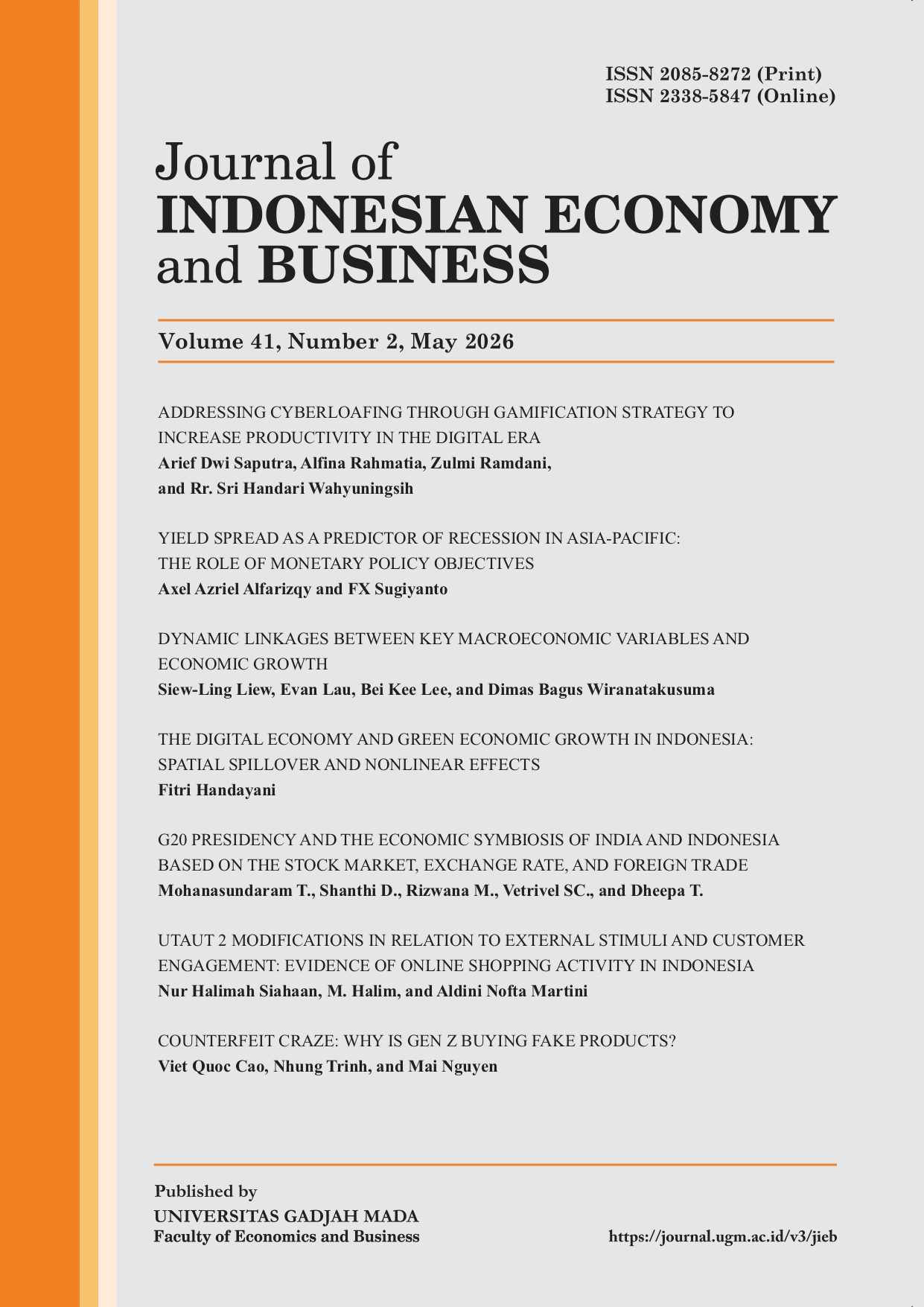
Dynamic Linkages Between Key Macroeconomic Variables and Economic Growth
Corresponding Author(s) : Evan Lau
Journal of Indonesian Economy and Business,
Vol 41 No 2 (2026): May
Abstract
Introduction/Main Objectives: This study investigates the dynamic linkages between Malaysia’s economic growth and the key macroeconomic variables of foreign direct investment (FDI), inflation, interest rates, and exchange rates, using annual time series data from 1990 to 2019. Background Problems: Malaysia’s economic progress is closely tied to macroeconomic stability and external financial flows, yet fluctuations in inflation, interest rates, and exchange rates often create uncertainty that may weaken the effectiveness of FDI as a catalyst for growth. Novelty: This study offers a comprehensive empirical assessment by integrating long-run cointegration analysis with short-run causality testing, providing new insights into the dominant role of FDI within Malaysia’s macroeconomic framework. Research Methods: Time series econometric techniques, including cointegration tests and Granger causality analyses, are applied to annual data covering 1990–2019 to capture equilibrium relationships and directional causality among the variables. Findings/Results: The findings confirm a long-run equilibrium relationship between economic growth, FDI, inflation, interest rates, and exchange rates, with Granger causality results indicating a unidirectional causal flow from FDI to other macroeconomic indicators. Conclusion: FDI emerges as a key driver of Malaysia’s economic growth, underscoring the importance of strategic investment policies and macroeconomic stability for sustaining long-term development.
Keywords
Download Citation
Endnote/Zotero/Mendeley (RIS)BibTeX
- Abang Abdul Rahman, D. H., Majidi, N., Huwaina, F., Harun, N. F. A., & Kasuma, J. (2017). Economic growth in Malaysia: A causality study on macroeconomic factors. Journal of Entrepreneurship and Business, 5(2), 61-70. DOI: 10.17687/JEB.0502.06
- Abd Kadir, N. Z., Ahmad Zaini, A., Mohd Zamburi, N. (2019). The impact of macroeconomic variables towards economic growth in Malaysia. International Journal of Development Research. 9(2), 26067-26069.
- Adaramola, A. O., & Dada, O. (2020). Impact of inflation on economic growth: Evidence from Nigeria. Investment Management and Financial Innovations, 17(2), 1–13. http://dx.doi.org/10.21511/imfi.17(2).2020.01
- Akalpler, E., & Duhok, D. (2018). Does monetary policy affect economic growth: Evidence from Malaysia. Journal of Econo¬mic and Administrative Sciences, 34(1), 2–20. https://doi.org/10.1108/JEAS-03-2017-0013
- Albar, M. & Ratnasari, R.T. (2022). Analysis of the effect of consumption expenditure, foreign direct investment, and manufac-turing industry moderated by labor force on growth of economy of OIC Countries during the Covid-19 pandemic. Jurnal Ekonomi Syariah Teori dan Terapan, 9(6), 787-799.https://orcid.org/0000-0003-1126-4012
- Alkhawaldeh, B. Y., Mahmood, S. and Jakada, A. H. (2020). An empirical assessment of the effect of taxes and interest rate on economic growth in Jordan: An application of dynamic autoregressive-distributed Lag. Research in World Economy, 11 (3), 92-98. https://doi.org/10.5430/rwe.v11n3p92
- Amin, R. M., Ghazali, M. F., & Habibullah, M. S. (2020). The impact of foreign direct investment and macroeconomic variables on Malaysia’s economic growth: Evidence from the ARDL approach. International Journal of Economics and Financial Issues, 10(3), 143–150. https://doi.org/10.32479/ijefi.9587
- Atigala, P., Maduwanthi, T., Gunathilake, V., Sathsarani, S. and Jayathilaka, R. (2022). Driving the pulse of the economy or the dilution effect: Inflation impacting econo-mic growth. PLoS ONE 17(8): e0273379. https://doi.org/10.1371/journal.pone.0273379
- Bank Negara Malaysia. (2023). Annual Report 2023. Kuala Lumpur: Bank Negara Malaysia. Retrieved from: https://www.bnm.gov.my/documents/20124/12142010/ar2023_en_book.pdf
- Borensztein, E., De Gregorio, J., & Lee, J.‑W. (1998). How does foreign direct investment affect economic growth? Journal of International Economics, 45(1), 115–135.https://doi.org/10.1016/S0022-1996(97)00033-0
- Caggese, A. & Pérez-Orive, A. (2022). How stimulative are low real interest rates for intangible capital? European Economic Review, 142. https://doi.org/10.1016/j.euroecorev.2021.103987
- Chowdhury, A. H. M. Y., Hamid, M. K., & Akhi, R. A. (2019). Impact of macroecono¬mic variables in economic growth: Bangla¬desh perspective. Information Management and Computer Science, 2(2), 19-22.
- Chrisharja, A.G. & Ali, H. (2023). The effect of inflation, unemployment and poverty on eocnomic growth in Indonesia. Dinasti International Journal of Digital Business Management, 4(4), 779-787. https://doi.org/10.31933/dijdbm.v4i4
- Crowder, W. J. & Wohar, M. E. (1998). Cointegration, forecasting and international stock prices, Global Finance Journal, 9(2), 181-204.https://doi.org/10.1016/S1044-0283(98)90003-5
- Daboh, F., Duramany-Lakkoh, E. K. & Knox-Goba, T. L. (2024). Analyzing the structural relationship between money supply, inflation, and economic growth in Sierra Leone: A VAR model approach. Theoretical Economics Letters, 14 (4). https://doi.org/10.4236/tel.2024.144080
- Darman & Aryusmar (2020). The effect of household consumption, investment, government expenditures and net exports on Indonesia’s GDP in Jokowi-JK Era. Psychology And Education:An Interdi-sciplinary Journal. 57(8), 1005-1008. https://doi.org/10.17762/pae.v57i8.1318
- Department of Statistics Malaysia. (2020). Performance of gross domestic product (GDP) by state, 2020. https://www.dosm.gov.my/v1/index.php?r=column/ctheme&menu_id=TE5CRUZCblh4ZTZMODZIbmk2aWRRQT09&bul_id=YnhhZ2g5QlpZWG9RcVNwTGhLaHE4UT09
- Department of Statistics Malaysia. (2021). Malaysia economic performance 2020. https://www.dosm.gov.my/index.php/portal-main/release-content/malaysia-economic-performance-2020
- Department of Statistics Malaysia. (2023). Poverty rates in Malaysia from 1970 to 2022. OpenDOSM. https://open.dosm.gov.my/data-catalogue/hh_poverty
- Department of Statistics Malaysia. (2025). Poverty in Malaysia, 2024.
- https://www.dosm.gov.my/portal-main/release-content/poverty-in-malaysia-2024
- Dickey, D. A., & Fuller, W. A. (1979). Distri-bution of the estimators for autoregressive time series with a unit root. Journal of the American Statistical Association, 74(366), 427–431. https://doi.org/10.2307/2286348
- Dickey, D. A., & Fuller, W. A. (1981). Likelihood ratio statistics for autoregressive time series with a unit root. Econometrica, 49(4), 1057–1072. https://doi.org/10.2307/1912517
- Dinh, T. H. T., Vo, D. H., Vo, A. T., & Nguyen, T. C. (2019). Foreign direct investment and economic growth in the short run and long run: Empirical evidence from developing countries. Journal of Risk and Financial Management, 12(4), 176. https://doi.org/10.3390/jrfm12040176
- Ebimobowei, A. (2022) Oil Revenue and economic growth of Nigeria: 1990-2019. African Journal of Economics and Sustainable Development, 5(1), 17-46. https://doi.org/10.52589/AJESD-JWZXIFNW
- Economic Planning Unit (EPU). (2021). Eleventh Malaysia Plan, 2016–2020: Mid-term review. Prime Minister’s Department, Malaysia.
- Economic Planning Unit. (EPU). (2023). Mid‑term review of the Twelfth Malaysia Plan, 2021–2025: Advancing sustainable and inclusive development. Prime Minister’s Department, Malaysia.
- Elias Elwer, N.M. & Saqfalhait, N.I. (2023). Household transportation expenditure in Jordan: An analytical study. Zarqa Journal for Research and Studies in Humanities, 23(1), 208-214. https://doi.org//10.12816/0061444
- El-Rasheed, S. & Abdullah, B.M. (2022). Revisiting foreign direct investment – Economic growth nexus in Nigeria: An ARDL approach. Journal of Economics and Allied Research, 7(4), 29-47.
- Enders, W. (2015). Applied Econometric Time Series (4th ed.). Wiley.
- Engle, R. F., & Granger, C. W. J. (1987). Co-integration and error correction: Represen¬tation, estimation, and testing. Econome¬trica, 55(2), 251–276. https://doi.org/10.2307/1913236
- Girdzijauskas, S., Streimikiene, D., Griesiene, I., Mikalauskiene, A. and Kyriakopoulos, G.L. (2021). New approach to inflation phenol¬mena to ensure sustainable economic growth. Sustainability, 14(1), 518.https://doi.org/10.3390/su14010518
- Hobbs, S., Paparas, D., & AboElsoud, E. M. (2021). Does foreign direct investment and trade promote economic growth? Evidence from Albania. Economies, 9(1), 1-19. https://doi.org/10.3390/economies9010001
- Hu, Q. & Wang, L. (2024). Economic growth effects of public health expenditure in OECD countries: An empirical study using the dynamic panel threshold model. Heliyon, 10(4), 1-13. https://doi.org/10.1016/j.heliyon.2024.e25684
- Huseynli, N. (2022). Econometric Analysis of the relationship between tourism revenues, inflation and economic growth: The Case of Morocco and South Africa. African Journal of Hospitality, Tourism and Leisure, 11(1), 135-146.https://doi.org/10.46222/ajhtl.19770720.216
- Hussin, F., Ros, N. M., & Noor, M. S. Z. (2013). Determinants of economic growth in Malaysia 1970-2010. Asian Journal of Empirical Research,3(9), 1140-1151.
- IMF. (2021). Malaysia: 2021 article IV consul¬tation—Press Release; Staff Report. International Monetary Fund.
- Impin, P.D. &Kok, S.C. (2021). The effect of inflation rate, interest rate and unem-ployment Rate on the economic growth of Malaysia. Malaysian Journal of Business and Economics, 8(1), 125-140. https://doi.org/10.51200/mjbe.vi.3322
- Jacobs, J., Ogawa, K., Sterken, E., & Tokutsu, I. (2020). Public debt, economic growth and the real interest rate: A panel VAR approach to EU and OECD countries. Applied Economics, 52(12), 1377–1394. https://doi.org/10.1080/00036846.2019.1673301
- Jiao, L., Zhou, D. & Xu, R. (2024). Resource dynamics and economic expansion: Unveiling the asymmetric effects of natural resources and FDI on economic growth with a lens on energy efficiency. Resources Policy, 89, 1-10. https://doi.org/10.1016/j.resourpol.2023.104611
- Johansen, S. (1988). Statistical analysis of cointegration vectors.Journal of Economic Dynamics and Control, 12(2–3), 231–254.https://doi.org/10.1016/0165-1889(88)90041-3
- Johansen, S., & Juselius, K. (1990). Maximum likelihood estimation and inference on cointegration—with applications to the demand for money. Oxford Bulletin of Economics and Statistics, 52(2), 169–210. https://doi.org/10.1111/j.1468-0084.1990.mp52002003.x
- Johansen, S. (1995). Likelihood-based inference in cointegrated vector autoregressive models. Oxford University Press.
- Kashyap, A.K. & Stein, J.C. (2023). Monetary policy when the Central Bank shapes financial-market sentiment. Journal of Economic Perspectives, 37(1), 53-76. https://doi.org/10.1257/jep.37.1.53.
- Katoka, B. & Dostal, J.M. (2022). Natural resources, international commodity prices and economic performance in Sub-Saharan Africa (1990-2019). Journal of African Economies, 31(1), 53-74. https://doi.org/10.1093/jae/ejab014
- Khan, I., Xue, J., Zaman, S. & Mehmood, Z. (2023). Nexus between FDI, economic growth, industrialization, and employment opportunities: Empirical evidence from Pakistan. Journal of the Knowledge Economy, 14, 3153–3175. https://doi.org/10.1007/s13132-022-01006-w
- Konyuncu, C. & Unal, H. (2020) The link between GDP and household consumption expenditure in the Long-Run in Turkey: ARDL Analysis. Balkan and Near Eastern Journal of Social Sciences, 6(1), 171-177.
- Kryeziu, A. (2016). The impact of macroeco-nomic factors in economic growth. European Scientific Journal, 12(7), 1857-7431. http://dx.doi.org/10.19044/esj.2016.v12n7p331
- Kumari, R., Shabbir, M.S., Saleem, S., Yahya Khan, G., Abbasi, B.A. & Lopez, L.B. (2023). An empirical analysis among foreign direct investment, trade openness and economic growth: Evidence from the Indian economy. South Asian Journal of Business Studies, 12(1), 127-149. https://doi.org/10.1108/SAJBS-06-2020-0199
- Kwiatkowski, D., Phillips, P. C. B., Schmidt, P., & Shin, Y. (1992). Testing the null hypothesis of stationarity against the alternative of a unit root: How sure are we that economic time series have a unit root? Journal of Econometrics, 54(1–3), 159–178.https://doi.org/10.1016/0304-4076(92)90104-Y
- Lewis, W. A. (1954). Economic development with unlimited supplies of labour. The Manchester School, 22(2), 139–191. https://doi.org/10.1111/j.1467-9957.1954.tb00021.x
- Li, M. (2024). Study of the impact of inflation, money supply on economic growth. Journal of Innovation and Development, 7 (2), 41- 46.https://doi.org/10.54097/3rv5v068
- Lucas, R. E. (1988). On the mechanics of economic development. Journal of Mone¬tary Economics, 22(1), 3–42. https://doi.org/10.1016/0304-3932(88)90168-7
- Mark, O. (2024). Exploring the interrelation between inflation, interest rate, exchange rate and economic growth. Role of COVID-19 cases: Evidence from the UK. Advance Journal of Business Management and Social Science, 4 (2), 1-20.
- Mawutor, J.K.M., Sogah, E., Christian, F.G. & Aboagye, D. (2023). Foreign direct investment, remittances, real exchange rate, imports, and economic growth in Ghana: An ARDL approach. Cogent Economics and Finance, 11(1).https://doi.org/10.1080/23322039.2023.2185343
- Mustafa, A. M. M. (2019). Contribution of tourism and foreign direct investment to gross domestic product: econometric analysis in the case of Sri Lanka. The Journal of Asian Finance, Economics and Business, 6(4), 109–114. https://doi.org/10.13106/jafeb.2019.vol6.no4.109
- Ndlovu, D. (2024). Evaluating the impact of foreign direct investment on economic growth in Zambia;1996-2020. East African Finance Journal, 3 (1), 107-30. https://doi.org/10.59413/eafj/v3.i1.5
- Nguyen, A. T. (2022a). The relationship between economic growth, foreign direct investment, trade openness, and unemploy¬ment in South Asia. Asian Academy of Management Journal, 22 (2), 21-40. https://doi.org/10.21315/aamj2022.27.2.2
- Nguyen, M.T. (2022b). Foreign direct investment and economic growth: The role of financial development. Cogent Business & Management, 9, 1-15. https://doi.org/10.1080/23311975.2022.2127193
- Oroud, Y., Almahadin, H., A., Alkhazaleh, M. & Shneikat, B. (2023). Evidence from an emerging market economy on the dynamic connection between financial development and economic growth. Research in Globalization, 6, 1-5. https://doi.org/10.1016/j.resglo.2023.100124
- Pasaribu, P. & Mindosa, B. (2021). The bank specific determinants of loan growth and stability: Evidence from Indonesia. Journal of Indonesian Economy and Business, 36 (2), 2021, 93–123. https://doi.org/10.22146/jieb.v36i2.1385
- Pesaran, M. H., Shin, Y., & Smith, R. J. (2001). Bounds testing approaches to the analysis of level relationships. Journal of Applied Econometrics, 16(3), 289–326. https://doi.org/10.1002/jae.616
- Phillips, P. C. B., & Perron, P. (1988). Testing for a unit root in time series regression. Biometrika, 75(2), 335–346. https://doi.org/10.1093/biomet/75.2.335
- Raja Aziz, R. N. A. & Azmi, A. (2017). Factor affecting gross domestic product (GDP) growth in Malaysia. International Journal of Real Estate Studies, 11(4), 61-67.
- Ravallion, M. (2020). Ethnic inequality and poverty in Malaysia since May 1969. Part 2: Poverty. World Development, 134, 105039. https://doi.org/10.1016/j.worlddev.2020.105039
- Rehman, A., Cismas, L.M. & Milin, I.A. (2022). The three evils: Inflation, poverty and unemployment’s shadow on economic progress - A novel exploration from the asymmetric technique. Sustainability, 14(4), 8642.https://doi.org/10.3390/su14148642
- Ridzuan, A., Razak, M., Ibrahim, Z., Noor, A., & Ahmed, E. (2014). Household consumption, domestic investment, govern¬ment expenditure and economic growth: New evidence from Malaysia. Journal of Scientific Research and Reports, 3(17), 2373–2381. https://doi.org/10.9734/JSRR/2014/11335.
- Romer, P. M. (1986). Increasing returns and long-run growth. Journal of Political Economy, 94(5), 1002–1037. https://doi.org/10.1086/261420
- Rumbia, W. A., Muthalib, A. A., Abbas, B., Adam, P., Millia, H., Saidi, L. O., & Azis, M. I. (2020). Crude oil price, household spending and economic growth in the ASEAN-4 region: An analysis of nonlinear panel autoregressive distributed lag. International Journal of Energy Economics and Policy, 10(4), 437–442. https://doi.org/10.32479/ijeep.9293
- Salim, N. J., Mustaffa, R., & Hanafiah, N. J. A. (2015). FDI and economic growth Linkages in Malaysia. Mediterranean Journal of Social Sciences, 6(4), 652-657. 10.5901/mjss.2015.v6n4s2p652
- Sarker, B. and Khan, F. (2020). Nexus between foreign direct Investment and economic growth in Bangladesh: An augmented autoregressive distributed lag bounds testing approach. Financial Innovation, 6 (10), 1-18. https://doi.org/10.1186/s40854-019-0164-y
- Saxena, H., & Bansal, P. (2019). Relationship between economic factors and economic growth. SSRN Electronic Journal. Retrieved from https://papers.ssrn.com/sol3/papers.cfm?abstract_id=3319961http://dx.doi.org/10.2139/ssrn.3319961
- Semuel, H. & Nurina, S. (2015). Analysis of the effect of inflation, interest rates, and exchange rates on gross domestic product (GDP) in Indonesia. Proceedings of the International Conference on global business, economics, finance and social sciences. Retrieved from: http://repository.petra.ac.id/17008/1/Publikasi1_94033_2021.pdf
- Smith, A. (1776). An inquiry into the nature and causes of the wealth of nations. London: W. Strahan and T. Cadell.
- Solow, R. M. (1956). A contribution to the theory of economic growth. Quarterly Journal of Economics, 70(1), 65–94. https://doi.org/10.2307/1884513
- Stievany, G.M. & Jalunggono, G. (2022). Analysis of the effect of inflation, exports, and imports on Indonesia’s economic growth. Journal of Management, Accounting, General Finance and International Economic Issues, 1(3), 1-14.
- Sudibyo, I. (2024). Consumption contribution to economy growth. ScienceOpen, DOI:10.14293/S2199-1006.1.SOR-.PPVQHAO.v4.
- Sujianto, A. E., Pantas, P. E., Mashudi, M., Pambudi, D. S., & Narmaditya, B. S. (2020). Do real interest rate, gross domestic savings and net exports matter in economic Growth? Evidence from Indonesia. The Journal of Asian Finance, Economics and Business, 7(11), 127–135. https://doi.org/10.13106/jafeb.2020.vol7.no11.127
- Tan, C. T., Mohamed, A., Habibullah, M. S., & Lee, C. (2020). The impacts of monetary and fiscal policies on economic growth in Malaysia, Singapore and Thailand. South Asian Journal of Macroeconomics and Public Finance, 9(1), 114–130. https://doi.org/10.1177/227797872090606
- Thawley, C., Crystallin, M. and Verico, K. (2024). Towards a higher growth path for Indonesia. Bulletin of Indonesian Economic Studies, 60 (3), 247-282. https://doi.org/10.1080/00074918.2024.2432035
- Todaro, M. P., & Smith, S. C. (2020). Economic development (13th ed.). Pearson.
- Uddin, I. & Ullah, R. (2024). The nexus amongst the interest rate, inflation and economic growth in Pakistan: Evidence from simultaneous equation modeling. Economic Alternatives (1), 45-58. https://doi.org/10.37075/EA.2024.1.04
- UNCTAD. (2023). World Investment Report 2023: Investing in Sustainable Energy for All. Geneva: United Nations Conference on Trade and Development. Retrieved from https://unctad.org/publication/world-investment-report-2023
- World Bank. (2022). Aiming high: Navigating the next stage of Malaysia’s development. Washington, DC: World Bank.
- World Bank (2023). Global economy’s speed limit set to fall to three-decade low. https://www.worldbank.org/en/news/press-release/2023/03/27/global-economy-s-speed-limit-set-to-fall-to-three-decade-low
- World Bank (2024). Malaysia economic monitor: Navigating structural transitions. Washington, D.C.: World Bank.
- World Bank. (2025a). Malaysia: Poverty and Equity Brief, April 2025. Retrieved from https://documents.worldbank.org/en/publication/documents-reports/documentdetail/099735404212512994
- World Bank. (2025b). The World Bank in Malaysia – Overview. Retrieved from https://www.worldbank.org/en/country/malaysia/overview
- Yazdi, S. K. (2019). Structural breaks, international tourism development and economic growth. Economic Research-Ekonomska Istraživanja, 32(1), 1765–1776. https://doi.org/10.1080/1331677x.2019.1638279
- Yusuf, A., Akwe, O. M., Farouq, B. U., Nasiru, L. M. & Valati, R. (2024). Impact of credit, interest rate, and inflation on Small and Medium Enterprises productivity in Nigeria, EPRA International Journal of Research and Development (IJRD) Volume, 9 (4), 380-390.https://doi.org/10.36713/epra16607
- Zahra Wijaya, A.H., Ismail, M. & Santosa, D.B. (2023). The Role of The central bank on economic growth (Study Case: Indonesia). International Journal of Accounting Finance, 6(1). https://doi.org/10.32535/ijafap.v6i1.2134
- Zhao, S., Zhang, Y., Iftikhar, H., Ullah, A., Mao, J. and Wang, T. (2022). Dynamic Influence of digital and Technological advancement on sustainable economic growth in belt and road initiative countries. Sustainability, 14(23), 15782.https://doi.org/10.3390/su142315782
- Zonta, E. (2025). From economic security to legal uncertainty: Exploring the impact of the FDI screening regulation and foreign subsidies regulation on mergers and acquisitions in the EU. Journal of European Competition Law & Practice, 16(3), 167–178.https://doi.org/10.1093/jeclap/lpaf043