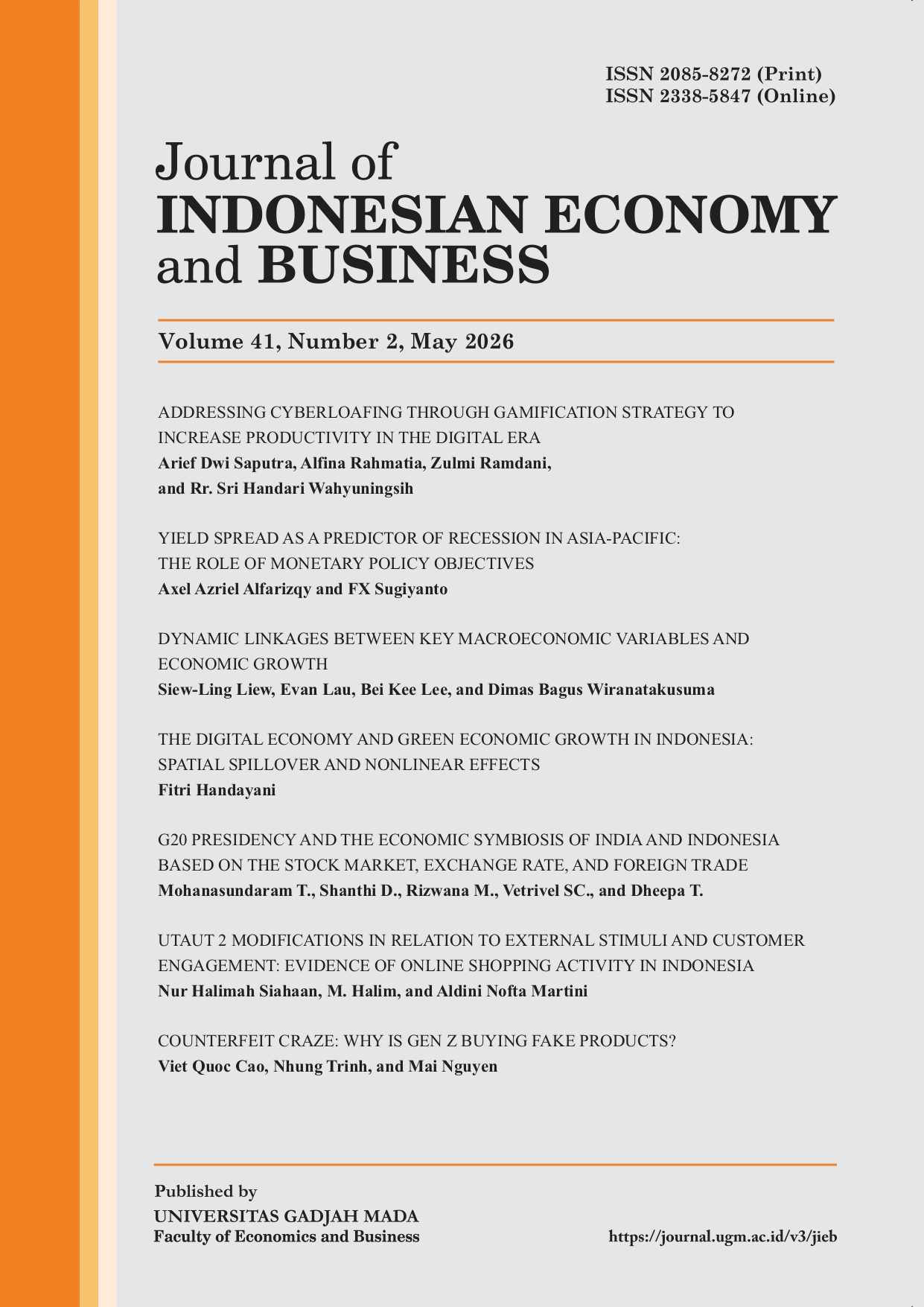
Issue
Date Log

This work is licensed under a Creative Commons Attribution-ShareAlike 4.0 International License.
Copyright
Upon acceptance of an article, authors transfer copyright to the JIEB as part of a journal publishing agreement, but authors still have the right to share their article for personal use, internal institutional use, and for any use permitted under the CC BY-SA license
Open Access
Articles are freely available to the public without any subscription with permitted reuse. For open access articles, permitted third party (re)use is defined by the following Creative Commons user licenses: Creative Commons Attribution (CC BY-SA).
Yield Spread as a Predictor of Recession in Asia-Pacific: The Role of Monetary Policy Objectives
Corresponding Author(s) : Axel Azriel Alfarizqy
Journal of Indonesian Economy and Business,
Vol 41 No 2 (2026): May
Abstract
Introduction/Main Objectives: This research examines the predictive power and stability of yield spread in relation to recession for five Asia-Pacific Countries, with monetary policy as the control variable. Background Problems: Yield spread has been extensively studied in industrial countries, but its impact on the real economy in developing regions remains underexplored. Moreover, the informational content underlying the yield spread is still unclear. Novelty: This research incorporates the role of monetary policy objectives in influencing the informational content and stability of the predictive power of yield spread. Research Methods: The research utilizes a fixed effects panel probit approach to conduct in-sample forecasting using monthly secondary data from October 2004 to May 2022. To test parameter stability, Likelihood Ratio Tests were also used. Findings/Results: The yield spread outperforms money supply and stock index for predicting recessions, with an optimal lag of three months. Monetary policy plays a crucial role as every inversion of the yield curve is associated with an interest rate hike, but the model performs better when central bank have prioritized output stabilization and the relationship between interest rate and output is not disturbed. Conclusion: Yield spread is a reliable predictor of recession in Asia-Pacific, but its predictive power depends on the interest rate–output relationship. Therefore, central banks shouldn't use the yield spread during zero lower bound or supply shock conditions.
Keywords
Download Citation
Endnote/Zotero/Mendeley (RIS)BibTeX
- Andrews, D. W. K., & Fair, R. C. (1988). Inference in nonlinear econometric models with structural change. The Review of Economic Studies, 55(4), 615–640.
- https://doi.org/10.2307/2297408
- Bauer, M., & Mertens, T. (2018). Economic forecasts with the yield curve. FRBSF Economic Letter,7(1), 1–5.
- https://www.frbsf.org/research-and-insights/publications/economic-letter/2018/03/economic-forecasts-with-yield-curve/
- Bernard, H., & Gerlach, S. (1998). Does the term structure predict recessions? The inter¬national evidence. International Jour¬nal of Finance & Economics, 3(3), 195–215.
- https://doi.org/10.1002/(SICI)1099-1158(199807)3:3<195::AID-IJFE81>3.0.CO;2-M
- Bloomberg L.P. (2024). ECST – World Economic Statistics. Bloomberg Terminal.
- Chauvet, M., & Potter, S. (2002). Predicting a recession: Evidence from the yield curve in the presence of structural breaks. Economics Letters, 77(2), 245–253. https://doi.org//10.1016/S0165-1765(02)00128-3
- Chen, G., Valadkhani, A., & Grant, B. (2016). How useful is the yield spread as a predictor of growth in Australia? Journal of Economic Studies, 43(2), 222–241.
- https://doi.org/10.1108/JES-09-2014-0159
- Chinn, M., & Kucko, K. (2015). The predictive power of the yield curve across countries and time. International Finance, 18(2), 129–156.
- https://doi.org/10.1111/infi.12064
- Christiansen, C., Eriksen, J. N., & Møller, S. V. (2014). Forecasting US recessions: The role of sentiment. Journal of Banking & Finance, 49(1), 459–468.
- https://doi.org/10.1016/j.jbankfin.2014.06.017
- Driscoll, J. C., & Kraay, A. C. (1998). Consistent covariance matrix estimation with spatially dependent panel data. The Review of Economics and Statistics, 80(4), 549–560.
- https://doi.org/10.1162/003465398557825
- Dueker, M. (1997). Strengthening the case for the yield curve as a predictor of U.S. recessions. Federal Reserve Bank of St. Louis Review, 3(1), 41–51.
- https://doi.org/10.20955/R.79.41-51
- Estrella, A., & Hardouvelis, G. A. (1991). The term structure as a predictor of real economic activity. The Journal of Finance, 46(2), 555–576.
- https://doi.org/10.2307/2328836
- Estrella, A. (1998). A new measure of fit for equations with dichotomous dependent variables. Journal of Business & Economic Statistics, 16(2), 198–205.
- https://doi.org/10.1080/07350015.1998.10524753
- Estrella, A., & Mishkin, F. S. (1998). Predicting U.S. recessions: Financial variables as leading indicators. The Review of Econo¬mics and Statistics, 80(1), 45–61.
- https://doi.org/10.1162/003465398557320
- Estrella, A., Rodrigues, A. R., & Schich, S. (2003). How stable is the predictive power of the yield curve? Evidence from Germany and the United States. The Review of Economics and Statistics, 85(3), 629–644.
- https://doi.org/10.1162/003465303322369777
- Estrella, A. (2005). Why does the yield curve predict output and inflation? The Economic Journal, 115(505), 722–744.
- https://doi.org/10.1111/j.1468-0297.2005.01017.x
- Fendel, R., Mai, N., & Mohr, O. (2021). Recession probabilities for the Eurozone at the zero lower bound: Challenges to the term spread and rise of alternatives. Journal of Forecasting, 40(6), 1000–1026.
- https://doi.org/10.1002/for.2751
- Gujarati, D. N. (2021). Essentials of econo-metrics. New York, United States: Sage Publications.
- Hall, A. D., Anderson, H. M., & Granger, C. W. J. (1992). A Cointegration analysis of treasury bill yields. The Review of Economics and Statistics, 74(1), 116–126.
- https://doi.org/10.2307/2109549
- Hasse, J.-B., & Lajaunie, Q. (2022). Does the yield curve signal recessions? New evidence from an international panel data analysis. The Quarterly Review of Economics and Finance, 84(1), 9–22.
- https://doi.org/10.1016/j.qref.2022.01.001
- Hubbansyah, A. K., & Husodo, Z. A. (2018). The interdependence between the financial sector and business sector in ASEAN 4 countries. Journal of Indonesian Economy and Business, 33(1), 77-94.
- https://doi.org/10.22146/jieb.28659
- Hwang, Y. (2019). Forecasting recessions with time-varying models. Journal of Macroeco¬nomics, 62(3), 103–153.
- https://doi.org/10.1016/j.jmacro.2019.103153
- International Capital Market Association (ICMA). (2023). The Asian International Bond Markets: Development and Trends, Third Edition, March 2023. Retrieved from https://www.icmagroup.org/assets/The-Asian-International-Bond-Markets-Development-and-Trends-brochure_March-2023.pdf
- Kauppi, H., & Saikkonen, P. (2008). Predicting U.S. recessions with dynamic binary response models. The Review of Economics and Statistics, 90(4), 777–791.
- https://doi.org/10.1162/rest.90.4.777
- Khomo, M., & Aziakpono, M. (2007). Fore-casting recession in South Africa: A comparison of the yield curve and other economic indicators. South African Journal of Economics, 75(5), 194–212.
- https://doi.org/10.1111/j.1813-6982.2007.00117.x
- Kim, S. (2021). Evolution of China economy and monetary policy: An Empirical evaluation using a TVP-VAR Model. East Asian Economic Review, 25(1), 73–97.
- http://doi.org/10.11644/KIEP.EAER.2021.25.1.391
- Kusumah, H., Asri, M., Setiawan, K., & Setiyono, B. (2022). The relationship between Asia Pacific markets during the financial crisis: VAR-Granger causality analysis. Journal of Indonesian Economy and Business, 37(2), 162-187.
- https://doi.org/10.22146/jieb.v37i2.1474
- Lutz, F. A. (1940). The structure of interest rates. The Quarterly Journal of Economics, 55(1), 36–62.
- https://doi.org/10.2307/1881665
- Mehl, A. (2009). The yield curve as a predictor and emerging Economies. Open Economies Review, 20(6), 683–716.
- https://doi.org/10.2139/ssrn.1002341
- Moneta, F. (2005). Does the yield spread predict recessions in the Euro Area? International Finance, 8(2), 263–301.
- https://doi.org/10.1111/j.1468-2362.2005.00159.x
- Ng, E. C. Y. (2012). Forecasting US recessions with various risk factors and dynamic probit models. Journal of Macroeconomics, 34(1), 112–125. https://doi.org//10.1016/j.jmacro.2011.11.001
- OECD. (2022). Composite leading indicator (CLI). Retrieved from: https://data.oecd.org/leadind/composite-leading-indicator-cli.htm
- Orphanides, A., & Kim, D. (2007). The bond market term premium: What is it, and how can we measure it? BIS Quarterly Review, 6(1), 27–40.
- https://www.bis.org/publ/qtrpdf/r_qt0706e.htm
- Andrews, D. W. K., & Fair, R. C. (1988). Inference in nonlinear econometric models with structural change. The Review of Economic Studies, 55(4), 615–640.
- https://doi.org/10.2307/2297408
- Bauer, M., & Mertens, T. (2018). Economic forecasts with the yield curve. FRBSF Economic Letter,7(1), 1–5.
- https://www.frbsf.org/research-and-insights/publications/economic-letter/2018/03/economic-forecasts-with-yield-curve/
- Bernard, H., & Gerlach, S. (1998). Does the term structure predict recessions? The inter¬national evidence. International Journal of Finance & Economics, 3(3), 195–215.
- https://doi.org/10.1002/(SICI)1099-1158(199807)3:3<195::AID-IJFE81>3.0.CO;2-M
- Bloomberg L.P. (2024). ECST – World Economic Statistics. Bloomberg Terminal.
- Chauvet, M., & Potter, S. (2002). Predicting a recession: Evidence from the yield curve in the presence of structural breaks. Economics Letters, 77(2), 245–253. https://doi.org//10.1016/S0165-1765(02)00128-3
- Chen, G., Valadkhani, A., & Grant, B. (2016). How useful is the yield spread as a predictor of growth in Australia? Journal of Economic Studies, 43(2), 222–241.
- https://doi.org/10.1108/JES-09-2014-0159
- Chinn, M., & Kucko, K. (2015). The predictive power of the yield curve across countries and time. International Finance, 18(2), 129–156.
- https://doi.org/10.1111/infi.12064
- Christiansen, C., Eriksen, J. N., & Møller, S. V. (2014). Forecasting US recessions: The role of sentiment. Journal of Banking & Finance, 49(1), 459–468.
- https://doi.org/10.1016/j.jbankfin.2014.06.017
- Driscoll, J. C., & Kraay, A. C. (1998). Consistent covariance matrix estimation with spatially dependent panel data. The Review of Economics and Statistics, 80(4), 549–560.
- https://doi.org/10.1162/003465398557825
- Dueker, M. (1997). Strengthening the case for the yield curve as a predictor of U.S. recessions. Federal Reserve Bank of St. Louis Review, 3(1), 41–51.
- https://doi.org/10.20955/R.79.41-51
- Estrella, A., & Hardouvelis, G. A. (1991). The term structure as a predictor of real economic activity. The Journal of Finance, 46(2), 555–576.
- https://doi.org/10.2307/2328836
- Estrella, A. (1998). A new measure of fit for equations with dichotomous dependent variables. Journal of Business & Economic Statistics, 16(2), 198–205.
- https://doi.org/10.1080/07350015.1998.10524753
- Estrella, A., & Mishkin, F. S. (1998). Predicting U.S. recessions: Financial variables as leading indicators. The Review of Econo¬mics and Statistics, 80(1), 45–61.
- https://doi.org/10.1162/003465398557320
- Estrella, A., Rodrigues, A. R., & Schich, S. (2003). How stable is the predictive power of the yield curve? Evidence from Germany and the United States. The Review of Economics and Statistics, 85(3), 629–644.
- https://doi.org/10.1162/003465303322369777
- Estrella, A. (2005). Why does the yield curve predict output and inflation? The Economic Journal, 115(505), 722–744.
- https://doi.org/10.1111/j.1468-0297.2005.01017.x
- Fendel, R., Mai, N., & Mohr, O. (2021). Recession probabilities for the Eurozone at the zero lower bound: Challenges to the term spread and rise of alternatives. Journal of Forecasting, 40(6), 1000–1026.
- https://doi.org/10.1002/for.2751
- Gujarati, D. N. (2021). Essentials of econome-trics. New York, United States: Sage Publications.
- Hall, A. D., Anderson, H. M., & Granger, C. W. J. (1992). A Cointegration analysis of treasury bill yields. The Review of Economics and Statistics, 74(1), 116–126.
- https://doi.org/10.2307/2109549
- Hasse, J.-B., & Lajaunie, Q. (2022). Does the yield curve signal recessions? New evidence from an international panel data analysis. The Quarterly Review of Economics and Finance, 84(1), 9–22.
- https://doi.org/10.1016/j.qref.2022.01.001
- Hubbansyah, A. K., & Husodo, Z. A. (2018). The interdependence between the financial sector and business sector in ASEAN 4 countries. Journal of Indonesian Economy and Business, 33(1), 77-94.
- https://doi.org/10.22146/jieb.28659
- Hwang, Y. (2019). Forecasting recessions with time-varying models. Journal of Macroeco¬nomics, 62(3), 103–153.
- https://doi.org/10.1016/j.jmacro.2019.103153
- International Capital Market Association (ICMA). (2023). The Asian International Bond Markets: Development and Trends, Third Edition, March 2023. Retrieved from https://www.icmagroup.org/assets/The-Asian-International-Bond-Markets-Development-and-Trends-brochure_March-2023.pdf
- Kauppi, H., & Saikkonen, P. (2008). Predicting U.S. recessions with dynamic binary response models. The Review of Economics and Statistics, 90(4), 777–791.
- https://doi.org/10.1162/rest.90.4.777
- Khomo, M., & Aziakpono, M. (2007). Forecasting recession in South Africa: A comparison of the yield curve and other economic indicators. South African Journal of Economics, 75(5), 194–212.
- https://doi.org/10.1111/j.1813-6982.2007.00117.x
- Kim, S. (2021). Evolution of China economy and monetary policy: An Empirical evaluation using a TVP-VAR Model. East Asian Economic Review, 25(1), 73–97.
- http://doi.org/10.11644/KIEP.EAER.2021.25.1.391
- Kusumah, H., Asri, M., Setiawan, K., & Setiyono, B. (2022). The relationship between Asia Pacific markets during the financial crisis: VAR-Granger causality analysis. Journal of Indonesian Economy and Business, 37(2), 162-187.
- https://doi.org/10.22146/jieb.v37i2.1474
- Lutz, F. A. (1940). The structure of interest rates. The Quarterly Journal of Economics, 55(1), 36–62.
- https://doi.org/10.2307/1881665
- Mehl, A. (2009). The yield curve as a predictor and emerging Economies. Open Economies Review, 20(6), 683–716.
- https://doi.org/10.2139/ssrn.1002341
- Moneta, F. (2005). Does the yield spread predict recessions in the Euro Area? International Finance, 8(2), 263–301.
- https://doi.org/10.1111/j.1468-2362.2005.00159.x
- Ng, E. C. Y. (2012). Forecasting US recessions with various risk factors and dynamic probit models. Journal of Macroeconomics, 34(1), 112–125.
- https://doi.org//10.1016/j.jmacro.2011.11.001
- OECD. (2022). Composite leading indicator (CLI). Retrieved from: https://data.oecd.org/leadind/composite-leading-indicator-cli.htm
- Orphanides, A., & Kim, D. (2007). The bond market term premium: What is it, and how can we measure it? BIS Quarterly Review, 6(1), 27–40.
- https://www.bis.org/publ/qtrpdf/r_qt0706e.htm
- Ozturk, H., & Pereira, L. F. V. N. (2013). Yield curve as a predictor of recessions: Evidence from panel data. Emerging Markets Finance & Trade, 49(3), 194–212.
- https://doi.org/10.2753/REE1540-496X4905S512
- Stock, J. H., & Watson, M. W. (2003). Fore-casting output and inflation: The role of asset prices. Journal of Economic Litera-ture, 41(3), 788–829.
- https://doi.org/10.1257/002205103322436197
- Taylor, J. B. (1993). Discretion versus policy rules in practice. Carnegie-Rochester Conference Series on Public Policy, 39(6), 195–214. https://doi.org/10.1016/0167-2231(93)90009-L
- Wright, J. (2006). The yield curve and predicting recessions. Board of Governors of the Federal Reserve System Finance and Economics Discussion Series.
- https://doi.org/10.2139/ssrn.899538