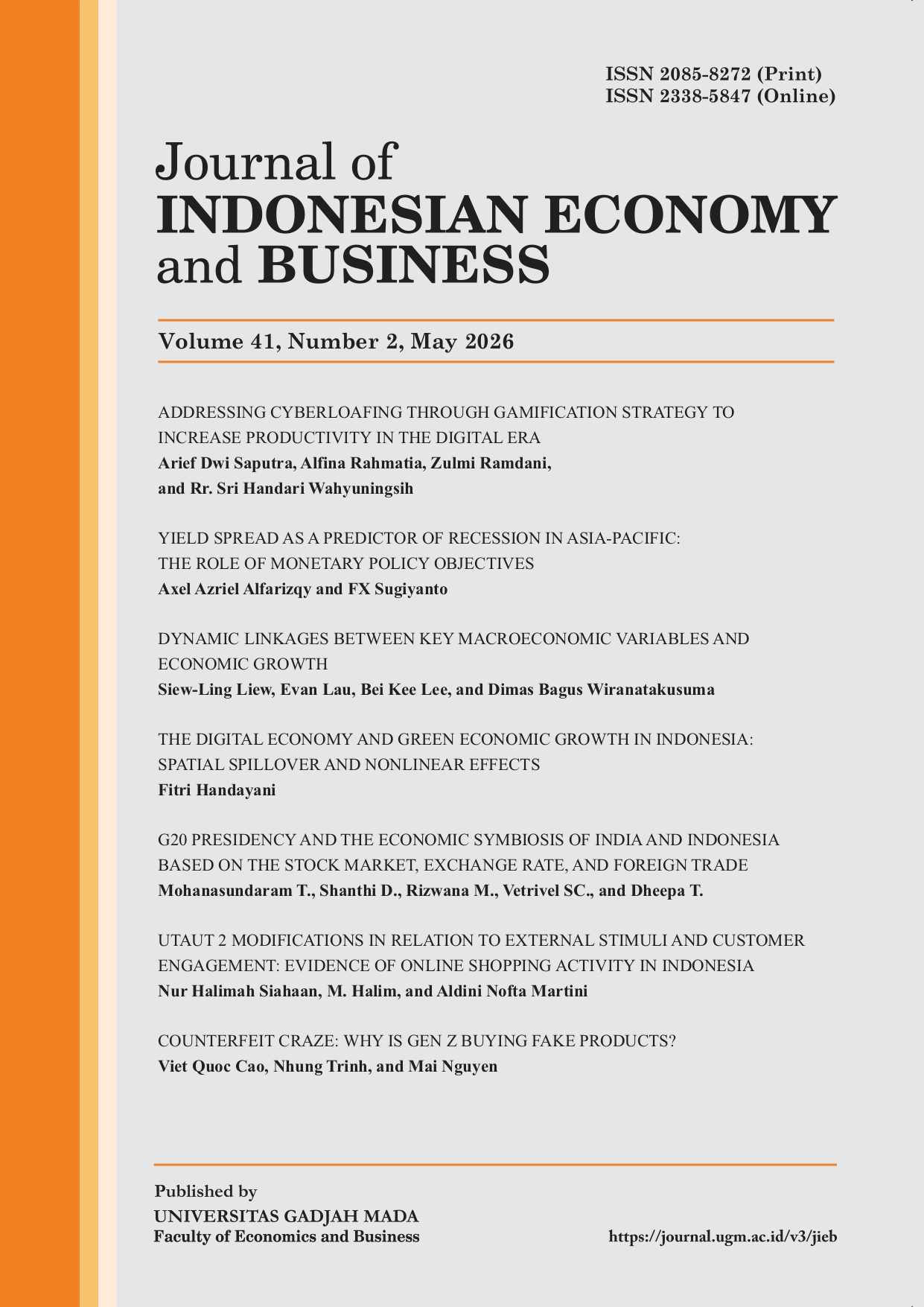
Issue
Date Log

This work is licensed under a Creative Commons Attribution-ShareAlike 4.0 International License.
Copyright
Upon acceptance of an article, authors transfer copyright to the JIEB as part of a journal publishing agreement, but authors still have the right to share their article for personal use, internal institutional use, and for any use permitted under the CC BY-SA license
Open Access
Articles are freely available to the public without any subscription with permitted reuse. For open access articles, permitted third party (re)use is defined by the following Creative Commons user licenses: Creative Commons Attribution (CC BY-SA).
G20 Presidency and the Economic Symbiosis of India and Indonesia Based on the Stock Market, Exchange Rate, and Foreign Trade
Corresponding Author(s) : T Mohanasundaram
Journal of Indonesian Economy and Business,
Vol 41 No 2 (2026): May
Abstract
Introduction/Main Objectives: The primary aim of the research is to assess the long-run and short-run dynamic interaction of the stock market, exchange rate and foreign trade between India and Indonesia during the period covered by their successive G20 presidencies. Background Problems: Given the economic significance of India and Indonesia, it is important to examine the performance of their stock market, exchange rate and foreign trade, and explore any connections between them, with the two-year period covered by their recent G20 presidencies providing an interesting window. Novelty: Despite India and Indonesia being emerging economic powerhouses, there are no studies exploring their economic nexus in the context of their successive G20 presidencies This period is chosen because under the G20 framework, both countries intensified their economic and climate collaboration, in turn enhancing their interdependence to make it pivotal. Research Methods: This study examines the empirical relationship between exchange rates, foreign trade, and the stock market indices of India and Indonesia during their G20 presidencies. It analyses historical data from December 2021 to November 2023 using econometric methods to understand the dynamic interactions among these variables. Finding/Results: Over the two years analysed, all economic variables are non-stationary and integrated at level one. Johansen's cointegration test shows long-run equilibrium between the chosen variables. The VECM suggests that short-run deviations in the JKSE are corrected by other variables. The OLS regression finds that changes in the JKSE are significantly explained by Indonesia's net trade. Additionally, the study confirms short-run interaction between the selected economic variables. Conclusion:The study uncovers connections between India and Indonesia's key economic variables, empowering both countries to make informed decisions on bilateral trade, currency policies, and economic cooperation. This understanding of short-term dynamics and long-term associations also assists investors in shaping investment strategies and managing risks effectively.
Keywords
Download Citation
Endnote/Zotero/Mendeley (RIS)BibTeX
- Abbas, G., Hammoudeh, S., Shahzad, S. J. H., Wang, S., & Wei, Y. (2019). Return and volatility connectedness between stock markets and macroeconomic factors in the G-7 countries. Journal of Systems Science and Systems Engineering, 28(1), 1–36. https://doi.org/10.1007/s11518-018-5371-y
- Abdul Karim, B., & Xin Ning, H. (2013). Driving forces of the ASEAN-5 stock markets integration. Asia-Pacific Journal of Business Administration, 5(3), 186–191. https://doi.org/10.1108/apjba-07-2012-0053
- Agoraki, M.E. K., Georgoutsos, D. A., & Kouretas, G. P. (2019). Capital markets integration and cointegration: Testing for the correct specification of stock market indices. Journal of Risk and Financial Management, 12(4), 186. https://doi.org/10.3390/jrfm12040186
- Ali, S., Butt, B., & Rehman, K. (2011). Comovement between emerging and developed stock markets: An investigation through cointegration analysis. World Applied Sciences Journal, 12(4), 395–403.
- Barakat, M. R., Elgazzar, S. H., & Hanafy, K. M. (2016). Impact of macroeconomic variables on stock markets: Evidence from emerging markets. International Journal of Economics and Finance, 8(1), 195–207.https://doi.org/10.5539/ijef.v8n1p195
- Bonga-Bonga, L., & Manguzvane, M. M. (2023). Stock market correlation and geographical distance: Does the degree of economic integration matter?.Munich Personal RePEc Archive, https://mpra.ub.uni-muenchen.de/116476/1/MPRA_paper_116476.pdf
- Borges, M. R. (2010). Efficient market hypothe¬sis in European stock markets. The European Journal of Finance, 16(7), 711–726. https://doi.org/10.1080/1351847X.2010.495477
- Camilleri, S. J., Scicluna, N., & Bai, Y. (2019). Do stock markets lead or lag macroeco¬nomic variables? Evidence from select European countries. The North American Journal of Economics and Finance, 48, 170–186. https://doi.org/10.1016/j.najef.2019.01.019
- Caporale, G. M., You, K., & Chen, L. (2019). Global and regional stock market integra-tion in Asia: A panel convergence approach. International Review of Financial Analysis, 65, 101381. https://doi.org/10.1016/j.irfa.2019.101381
- Danila, N. (2023). Revisiting financial volatility in the Indonesian Islamic stock market: GARCH–MIDAS approach. Journal of Indonesian Economy and Business, 38(2), 166–177. https://doi.org/10.22146/jieb.v38i2.5704
- Dey, S., & Sampath, A. (2020). Returns, volatility and spillover: A paradigm shift in India?.The North American Journal of Economics and Finance, 52, 101110. https://doi.org/10.1016/j.najef.2019.101110
- Dong, H., Bowers, H. M., & Latham, W. R. (2013). Evidence on the efficient market hypothesis from 44 global financial market indexes. Economics Research International, 2013(1), 238253. https://doi.org/10.1155/2013/238253
- Elangovan, R., Irudayasamy, F. G., & Parayitam, S. (2022). Testing the market efficiency in Indian stock market: evidence from Bombay Stock Exchange broad market indices. Journal of Economics, Finance and Administrative Science, 27(54), 313–327. https://doi.org/10.1108/JEFAS-04-2021-0040
- Endri, E., Abidin, Z., Simanjuntak, T. P., & Nurhayati, I. (2020). Indonesian stock market volatility: GARCH model. Montene¬grin Journal of Economics, 16(2), 7–17. https://doi.org/10.14254/1800-5845/2020.16-2.1
- Flavin, T. J., Hurley, M. J., & Rousseau, F. (2002). Explaining stock market correlation: A gravity model approach. The Manchester School, 70(S1), 87–106. https://doi.org/10.1111/1467-9957.70.s1.5
- Frankfurter, G. M., & McGoun, E. G. (2000). Market efficiency or behavioral finance: The nature of the debate. The Journal of Psychology and Financial Markets, 1(3–4), 200–210. 10.1207/S15327760JPFM0134_5
- Gonzalo, J. and Granger, C. (1995) ‘Estimation of common long-memory components in cointegrated systems’, Journal of Business and Economic Statistics, 13(1), pp. 27–35. https://doi.org/10.1080/07350015.1995.10524576
- Gupta, N., & Agarwal, V. (2011). Comparative study of distribution of Indian stock market with other Asian markets. International Journal of Enterprise Computing and Business Systems, 1(2), 1–20. https://ijecbs.com/July2011/43.pdf
- Jebran, K., & Iqbal, A. (2016). Examining volatility spillover between Asian countries’ stock markets. China Finance and Economic Review, 4(1), 6. https://doi.org/10.1186/s40589-016-0031-1
- Kusumah, H., Asri, M., Setiawan, K., & Setiyono, B. (2022). The relationship between Asia Pacific markets during the financial crisis: VAR–Granger causality analysis. Journal of Indonesian Economy and Business, 37(2), 162–187. https://doi.org/10.22146/jieb.v37i2.1474
- Lai, S., Cheng, T., Li, H., & Chien, S. P. (2013). Dynamic interactions among macroecono¬mic variables and stock indexes in Taiwan, Hong Kong, and China. Emerging Markets Finance and Trade, 49(suppl. 4), 213–235. https://doi.org/10.2753/ree1540-496x4905s415
- Latif, M., Arshad, S., Fatima, M., & Farooq, S. (2011). Market efficiency, market anoma¬lies, causes, evidences, and some behavioral aspects of market anomalies. Research Jour¬nal of Finance and Accounting, 2(9/10), 1–14.
- Lee, C.-H., & Chou, P.-I. (2012). Trading activity and financial market integration. Financial Review, 47(3), 589–616. https://doi.org/10.1111/j.1540-6288.2012.00341.x
- Lizarzaburu Bolaños, E. R., Burneo, K., Galindo, H., & Berggrun, L. (2015). Emerging markets integration in Latin America (MILA) stock market indicators: Chile, Colombia, and Peru. Journal of Economics, Finance and Administrative Science, 20(39), 74–83. https://doi.org/10.1016/j.jefas.2015.08.002
- Mishra, P. K., & Mishra, S. K. (2022). Is the impact of COVID-19 significant in deter-mining equity market integration? Insights from BRICS economies. Global Journal of Emerging Market Economies, 14(2), 137–162. https://doi.org/10.1177/09749101211070960
- Mohanasundaram, T., & Karthikeyan, P. (2015). Macroeconomic dynamics of foreign institu¬tional investments in India. International Journal of Management Research and Reviews, 5(1), 39–48.
- Nugroho, A. C., Herlambang, S., & Gusnanto, A. (2022). Short-term impact of COVID-19 pandemic on Indonesian stock prices. Jurnal Dinamika Manajemen, 13(2), 162–172. https://doi.org/10.15294/jdm.v13i2.35255
- Octavia, M., & Wijaya, C. (2020). Analysis of cointegration and causality relationship among selected stock market indexes in the world and Indonesia Stock Exchange Composite Index (IHSG) for the period 2005–2017. Open Journal of Business and Management, 8(3), 1226–1242. https://doi.org/10.4236/ojbm.2020.83079
- Paramati, S. R., Roca, E., & Gupta, R. (2016). Economic integration and stock market dynamic linkages: Evidence in the context of Australia and Asia. Applied Economics, 48(44), 4210–4226. https://doi.org/10.1080/00036846.2016.1153794
- Rahmayani, D., & Oktavilia, S. (2020). Does the COVID-19 pandemic affect the stock market in Indonesia?.Jurnal Ilmu Sosial dan Ilmu Politik, 24(1), 33–47. https://doi.org/10.22146/jsp.56432
- Roy-Chaudhury, R., & de Estrada, K. S. (2018). India, the Indo-Pacific and the Quad. Survival, 60(3), 181–194. https://doi.org/10.1080/00396338.2018.1470773
- Saji, T. G. (2022). Stock market linkages in Asia. Revisiting Granger causality eviden-ces. Theoretical and Applied Economics, 29(3), 151–168.
- Seth, N., & Panda, L. (2019). Time-varying correlation between Indian equity market and selected Asian and US stock markets. Global Business Review, 21(6), 1354–1375. https://doi.org/10.1177/0972150919856962
- Sharma, S. S., Thuraisamy, K., Madyan, M., & Laila, N. (2019). Evidence of price discovery on the Indonesian stock exchange. Economic Modelling, 83, 2–7. https://doi.org/10.1016/j.econmod.2019.09.005
- Sutha, M., & Vanitha, S. (2020). Effect of international stock markets and exchange rates movement on Indian stock market. Finance India, 34(3), 769–780.
- Thaddeus, K. J., Ngong, C. A., Nebong, N. M., Akume, A. D., Eleazar, J. U., & Onwumere, J. U. J. (2024). Selected macroeconomic determinants and economic growth in Cameroon (1970–2018): “Dead or alive” an ARDL approach. Journal of Business and Socio-Economic Development, 4(1), 1–19. https://doi.org/10.1108/jbsed-05-2021-0061
- Thangamuthu, M., Maheshwari, S., & Naik, D. R. (2022). Volatility spillover effects during pre-and-post COVID-19 outbreak on Indian market from the USA, China, Japan, Germany, and Australia. Journal of Risk and Financial Management, 15(9), 378. https://doi.org/10.3390/jrfm15090378
- Van Tassel, P. (2020). The law of one price in equity volatility markets. FRB of New York Staff Report, (953). http://dx.doi.org/10.2139/ssrn.3751612
- Woo, K. Y., Mai, C., McAleer, M., & Wong, W. K. (2020). Review on efficiency and anomalies in stock markets. Economies, 8(1), 20. https://doi.org/10.3390/economies8010020
- Worthington, A., & Higgs, H. (2004). Random walks and market efficiency in European equity markets. The Global Journal of Finance and Economics, 1(1), 59–78. http://eprints.qut.edu.au/2319/
- Wuthisatian, R. (2015). Cointegration of stock markets: The Case of Thailand. Journal of Asian Development, 6(3), 297–320. https://doi.org/10.1177/0974929215582244
- Yeyati, E. L., Schmukler, S. L., & Van Horen, N. (2009). International financial integration through the law of one price: The role of liquidity and capital controls. Journal of Financial Intermediation, 18(3), 432–463.https://doi.org/10.1016/j.jfi.2008.09.004