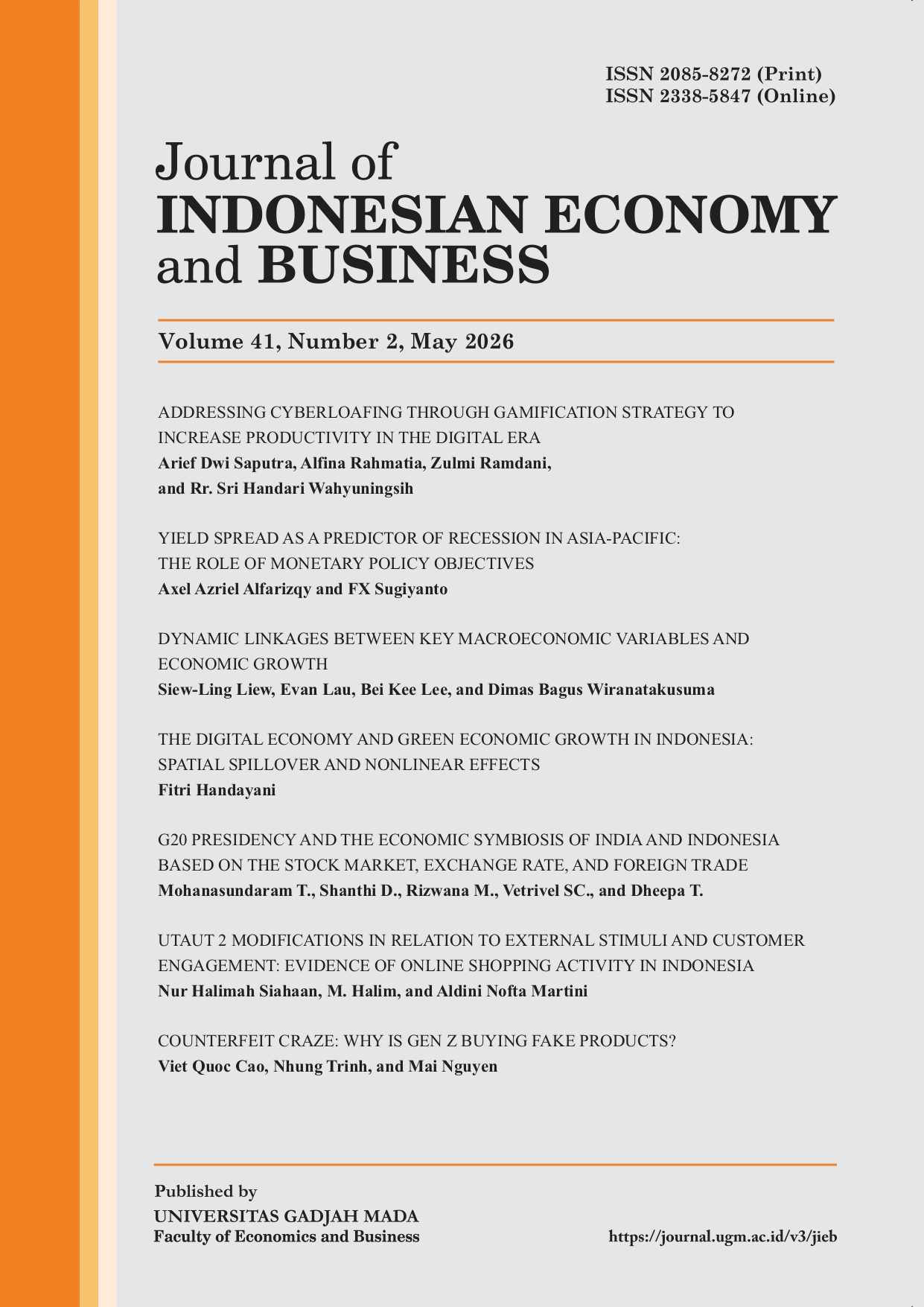
Issue
Date Log

This work is licensed under a Creative Commons Attribution-ShareAlike 4.0 International License.
Copyright
Upon acceptance of an article, authors transfer copyright to the JIEB as part of a journal publishing agreement, but authors still have the right to share their article for personal use, internal institutional use, and for any use permitted under the CC BY-SA license
Open Access
Articles are freely available to the public without any subscription with permitted reuse. For open access articles, permitted third party (re)use is defined by the following Creative Commons user licenses: Creative Commons Attribution (CC BY-SA).
Addressing Cyberloafing through Gamification Strategy to Increase Productivity in the Digital Era
Corresponding Author(s) : Arief Dwi Saputra
Journal of Indonesian Economy and Business,
Vol 41 No 2 (2026): May
Abstract
Introduction/Main Objectives: The digital era has led to cyberloafing behavior in the process of digital transformation, thereby reducing productivity. Background Problems: The increasing prevalence of cyberloafing behavior in the digital era presents a challenge. While it may alleviate boredom and stress, it can also lead to decreased workplace productivity if not appropriately managed. Novelty: The use of gamification strategies will be tested on cyberloafing factors towards increasing productivity. Research Methods: This study uses a quantitative approach. Data are collected using a questionnaire administered to a sample recruited using a purposive sampling technique. The total sample comprises 170 respondents who are employees in the micro, small and medium enterprise (MSME) business sector. The data is processed using SEM with the assistance of AMOS 24 software. Findings/Results: The findings in this study indicate positive and significant relationships between all variables and indicators. Conclusion: Cyberloafing behavior can be directed in a positive direction by increasing productivity through gamification strategies. This is because gamification addresses the psychological tendency of humans to become bored by creating a more pleasant work environment through interesting activities and experiences while still maintaining a focus on managerial goals through game design.
Keywords
Download Citation
Endnote/Zotero/Mendeley (RIS)BibTeX
- Agarwal, U. A., & Avey, J. B. (2020). Abusive supervisors and employees who cyberloafing: Examining the roles of psychological capital and contract breach. Internet Research, 30(3), 789–809. https://doi.org/10.1108/INTR-05-2019-0208
- Aghaz, A., & Sheikh, A. (2016). Cyberloafing and job burnout: An investigation in the knowledge-intensive sector. Computers in Human Behavior, 62, 51–60. https://doi.org/10.1016/j.chb.2016.03.069
- Akar, I., & Coskun, B. K. (2020). Exploring the relationship between creativity and cyberloafing of prospective teachers. Thinking Skills and Creativity, 38, 100724. https://doi.org/10.1016/j.tsc.2020.100724
- Andel, S. A., Kessler, S. R., Pindek, S., Kleinman, G., & Spector, P. E. (2019). Is cyberloafing more complex than we originally thought? Cyberloafing as a coping response to workplace aggression exposure. Computers in Human Behavior, 101, 124–130. https://doi.org/10.1016/j.chb.2019.07.013
- Askew, K., Buckner, J. E., Taing, M. U., Ilie, A., Bauer, J. A., & Coovert, M. D. (2014). Explaining cyberloafing: The role of the theory of planned behavior. Computers in Human Behavior, 36, 510–519. https://doi.org/10.1016/j.chb.2014.04.006
- Azmy, A. (2024). Employee satisfaction factors in the e-commerce company: The mediating role of employee engagement. Journal of Indonesian Economy and Business, 39(1), 28–56. https://doi.org/10.22146/jieb.v39i1.6936
- Barnes, C. M. (2012). Working in our sleep: Sleep and self-regulation in organizations. Organizational Psychology Review, 2(3), 234–257. https://doi.org/10.1177/2041386612450181
- Bolton, L. R., Harvey, R. D., Grawitch, M. J., & Barber, L. K. (2012). Counterproductive work behaviours in response to emotional exhaustion: A moderated mediational approach. Stress and Health, 28(3), 222–233. https://doi.org/10.1002/smi.1425
- Brull, S., Finlayson, S., Kostelec, T., Macdonald, R., & Krenzischeck, D. (2017). Using gamification to improve productivity and increase knowledge retention during orientation. Journal of Nursing Adminis¬tration, 47(9), 448–453. https://doi.org/10.1097/NNA.0000000000000512
- Charter, R. A. (1999). Sample size requirements for precise estimates of reliability, generalizability, and validity coefficients. Journal of Clinical and Experimental Neuropsychology, 21(4), 559–566. https://doi.org/10.1076/jcen.21.4.559.889
- Chavan, M., Galperin, B. L., Ostle, A., & Behl, A. (2021). Millennial’s perception on cyberloafing: Workplace deviance or cultural norm? Behaviour and Information Technology, 0(0), 1–18. https://doi.org/10.1080/0144929X.2021.1956588
- Creswell, J. W. (2019). Research design: Pendekatan metode kualitatif, kuantitatif dan campuran. Yogyakarta: Pustaka Pelajar.
- Cropanzano, R., & Mitchell, M. S. (2005). Social exchange theory: An interdisciplinary review. Journal of Management, 31(6), 874–900. https://doi.org/10.1177/0149206305279602
- Dale, S. (2014). Gamification: Making work fun, or making fun of work? Business Information Review, 31(2), 82–90. https://doi.org/10.1177/0266382114538350
- Derks, D., van Duin, D., Tims, M., & Bakker, A. B. (2015). Smartphone use and work-home interference: The moderating role of social norms and employee work engagement. Journal of Occupational and Organiza¬tional Psychology, 88(1), 155–177. https://doi.org/10.1111/joop.12083
- Durak, H. Y. (2020). Cyberloafing in learning environments where online social networking sites are used as learning tools: Antecedents and consequences. Journal of Educational Computing Research, 58(3), 539–569. https://doi.org/10.1177/0735633119867766
- Eerde, W. (2016). Procrastination and well-being at work. In Procrastination, Health, and Well-Being. Elsevier Inc. https://doi.org/10.1016/B978-0-12-802862-9.00011-6
- Epstein, D. S., Zemski, A., Enticott, J., Barton, C., & Hill, N. (2021). Tabletop board game elements and gamification interventions for health behavior change: Realist review and proposal of a game design framework. JMIR SERIOUS GAMES, 9(01), 1. https://doi.org/10.2196/23302
- Farooq, R., Vij, S., & Kaur, J. (2021). Innova-tion orientation and its relationship with business performance: Moderating role of firm size. Measuring Business Excellence, 25(3), 328–345. https://doi.org/10.1108/MBE-08-2020-0117
- Fornell, C., & Larcker, D. F. (1981). Evaluating Structural equation models with unobser¬vable variables and measurement error. Journal of Marketing Research, 18(1), 39–50. https://doi.org/10.1177/002224378101800104
- Ganster, D. C., & Rosen, C. C. (2013). Work stress and employee health: A multidisciplinary review. In Journal of Management (Vol. 39, Issue 5). https://doi.org/10.1177/0149206313475815
- Gerdenitsch, C., Sellitsch, D., Besser, M., Burger, S., Stegmann, C., Tscheligi, M., & Kriglstein, S. (2020). Work gamification: Effects on enjoyment, productivity and the role of leadership. Electronic Commerce Research and Applications, 43, 100994. https://doi.org/10.1016/j.elerap.2020.100994
- Ghozali. (2014). Structural equation modeling, metode alternatif dengan Partial Least Square (PLS). Edisi 4. Semarang: Badan Penerbit Universitas Diponegoro.
- Gökçearslan, Ş., Mumcu, F. K., Haşlaman, T., & Çevik, Y. D. (2016). Modelling smartphone addiction: The role of smartphone usage, self-regulation, general self-efficacy and cyberloafing in university students. Compu¬ters in Human Behavior, 63, 639–649. https://doi.org/10.1016/j.chb.2016.05.091
- Hadlington, L., & Parsons, K. (2017). Can cyberloafing and internet addiction affect organizational information security? Cyber¬psychology, Behavior, and Social Networking, 20(9), 567–571. https://doi.org/10.1089/cyber.2017.0239
- Halim, E., Joshua, Mailangkay, A., Nely, Sandi, R. T., & Poba-Nzaou, P. (2024). The Impact of gamification on customer engagement in small and medium enterprises. 2024 3rd International Conference on Creative Communication and Innovative Technology (ICCIT), 1–8. https://doi.org/10.1109/ICCIT62134.2024.10701259
- Hamari, J. (2017). Do badges increase user activity? A field experiment on the effects of gamification. Computers in Human Behavior, 71, 469–478. https://doi.org/10.1016/j.chb.2015.03.036
- Hamari, J., & Koivisto, J. (2015). Why do people use gamification services? Interna¬tional Journal of Information Management, 35(4), 419–431. https://doi.org/10.1016/j.ijinfomgt.2015.04.006
- Hu, L., & Bentler, P. M. (1999). Cutoff criteria for fit indexes in covariance structure analysis: Conventional criteria versus new alternatives. Structural Equation Modeling: A Multidisciplinary Journal, 6(1), 1–55. https://doi.org/10.1080/10705519909540118
- Jabid, A. W., Syahdan, R., Fahri, J., & Buamonabot, I. (2023). The Role of receiving technology on employee performance: Job satisfaction as mediation (Study on the government of Ternate City). Journal of Indonesian Economy and Business, 38(3), 229–253. https://doi.org/10.22146/jieb.v38i3.5361
- Jandaghi, G., Alvani, S. M., Zarei Matin, H., & Fakheri Kozekanan, S. (2015). Cyberloafing management in organizations. Iranian Jour¬nal of Management Studies, 8(3), 335–349. https://doi.org/10.22059/ijms.2015.52634
- Khan, J., Saeed, I., Ali, A., & Gul Nisar, H. (2021). The mediating role of emotional exhaustion in the relationship between abusive supervision and employee cyberloafing behaviour. Journal of Management and Research, 8(1), 160–178. https://doi.org/10.29145/jmr/81/080107
- Kim, S. (2021). How a company’s gamification strategy influences corporate learning: A study based on gamified MSLP (Mobile social learning platform). Telematics and Informatics, 57(August). https://doi.org/10.1016/j.tele.2020.101505
- Koay, K. Y., Soh, P. C. H., & Chew, K. W. (2017). Do employees’ private demands lead to cyberloafing? The mediating role of job stress. Management Research Review, 40(9), 1025–1038. https://doi.org/10.1108/MRR-11-2016-0252
- Korn, O., Boffo, S., & Schmidt, A. (2015). The effect of gamification on emotions – the potential of facial recognition in work environments. International Conference on Human-Computer Interaction, 9169, 489–499. https://doi.org/10.1007/978-3-319-20901-2_46
- Kumar, J. (2013). Gamification at work: Design¬ing engaging business software. Lecture Notes in Computer Science (Including Sub¬se¬ries Lecture Notes in Artificial Intelligen¬ce and Lecture Notes in Bioinformatics), 8013 LNCS(PART 2), 528–537. https:// doi.org/10.1007/978-3-642-39241-2_58
- Küpper, D. M., Klein, K., & Völckner, F. (2021). Gamifying employer branding: An integrating framework and research propositions for a new HRM approach in the digitized economy. Human Resource Management Review, 31(1), 0–1. https://doi.org/10.1016/j.hrmr.2019.04.002
- Kurniawan, D. T., Kusnayain, Y. I., Aulisaina, F. I., & Hakim, M. A. R. (2021). Exploring the existance of innovative work behavior among government employee: Have been there? Journal of Indonesian Economy and Business, 36(3), 272–282. https://doi.org/10.22146/jieb.v36i3.1404
- Kwahk, K. Y., & Park, D. H. (2016). The effects of network sharing on knowledge-sharing activities and job performance in enterprise social media environments. Computers in Human Behavior, 55, 826–839. https://doi.org/10.1016/j.chb.2015.09.044
- Lanzolla, G., Pesce, D., & Tucci, C. L. (2021). The digital transformation of search and recombination in the innovation function: Tensions and an Integrative Framework*. Journal of Product Innovation Manage¬ment, 38(1), 90–113. https://doi.org/10.1111/jpim.12546
- Lie, D., Saraswati, K. D. H., & Lie, D. S. (2023). Work engagement influences affective commitment: psychological capital and perceived organisation support as moderators. Journal of Indonesian Economy and Business, 38(2), 119–132. https://doi.org/10.22146/jieb.v38i2.6821
- Lim, P. K., Koay, K. Y., & Chong, W. Y. (2021). The effects of abusive supervision, emotional exhaustion and organizational commitment on cyberloafing: A moderated-mediation examination. Internet Research, 31(2), 497–518. https://doi.org/10.1108/INTR-03-2020-0165
- Lim, V. K. G., & Chen, D. J. Q. (2012). Cyberloafing at the workplace: Gain or drain on work? Behaviour and Information Technology, 31(4), 343–353. https://doi.org/10.1080/01449290903353054
- Lim, V. K. G., Teo, T. S. H., & Lua, E. W. K. (2019). Impact of daily commuting on cyberloafing and procrastination. ICIS 2019 Proceedings, 4.
- Liu, Manzhi, Yang, Y., Ren, Y., Jia, Y., Ma, H., Luo, J., Fang, S., Qi, M., & Zhang, L. (2024). What influences consumer AI chatbot use intention? An application of the extended technology acceptance model. Journal of Hospitality and Tourism Technology, 15(4), 667–689. https://doi.org/10.1108/JHTT-03-2023-0057
- Manzano-León, A., Camacho-Lazarraga, P., Guerrero, M. A., Guerrero-Puerta, L., Aguilar-Parra, J. M., Trigueros, R., & Alias, A. (2021). Between level up and game over: A systematic literature review of gamification in education. Sustainability (Switzerland), 13(4), 1–14. https://doi.org/10.3390/su13042247
- Metin-Orta, I., & Demirutku, K. (2020). Cyberloafing behaviors among university students and its relation to Hedonistic-Stimulation value orientation, cyberloafing attitudes, and time spent on the Internet. Current Psychology, (2014). https://doi.org/10.1007/s12144-020-00932-9
- Mutmainnah, D., Yuniarsih, T., Disman, Sojanah, J., Rahayu, M., & Nusannas, I. S. (2022). The impact of directive leadership on innovative work behavior: The mediation role of continuance commitment. Journal of Indonesian Economy and Business, 37(3), 268–286. https://doi.org/10.22146/jieb.v37i3.3377
- Nguyen, M. H., Büchi, M., & Geber, S. (2024). Everyday disconnection experiences: Exploring people’s understanding of digital well-being and management of digital media use. New Media & Society, 26(6), 3657–3678. https://doi.org/10.1177/14614448221105428
- Nivedhitha, K. S., Giri, G., & Pasricha, P. (2024). Gamification as a panacea to workplace cyberloafing: An application of self-determination and social bonding theories. Internet Research. https://doi.org/10.1108/INTR-07-2023-0558
- Oravec, J. A. (2015). Gamification and multigamification in the workplace: Expanding the ludic dimensions of work and challenging the work/play dichotomy. Cyberpsychology, 9(3). https://doi.org/10.5817/CP2015-3-6
- Ozler & Polat. (2012). Cyberloafing phenol-menon in organizations: Determinants and impacts. International Journal of eBusiness and eGovernment Studies, 4(2), 1–15.
- Pindek, S., Krajcevska, A., & Spector, P. E. (2018). Cyberloafing as a coping mechanism: Dealing with workplace boredom. Computers in Human Behavior, 86, 147–152. https://doi.org/10.1016/j.chb.2018.04.040
- Reinecke, L. (2019). Games at work: The recreational use of computer games during working hours. Cyberpsychology and Behavior, 12(4), 461–465. https://doi.org/10.1089/cpb.2009.0010
- Richter G., Raban D.R., R. S. (2015). Studying gamification: The effect of rewards and incentives on motivation. Gamification in Education and Business, 21–46. https://doi.org/10.1007/978-3-319-10208-5_2
- Rogers, M. (2004). Networks, firm size and innovation. Small Business Economics, 22(2), 141–153. https://doi.org/10.1023/B:SBEJ.0000014451.99047.69
- Rothwell, R. (1983). Innovation and firm size: A case for dynamic complementarity; or, is small really so beautiful? Journal of General Management, 8(3), 5–25. https://doi.org/10.1177/030630708300800301
- Saleh, M. D. I. (2018). The effect of cyberloafing on employee productivity. International Journal of Advanced and Applied Sciences, 5(4), 87–92. https://doi.org/10.21833/ijaas.2018.04.011
- Saputra, A. D., & Rahmatia, A. (2021). Gamification model as a business strategy for MSMEs in Indonesia. Journal of Accounting and Strategic Finance, 4(1), 91–107. https://doi.org/10.33005/jasf.v4i1.162
- Saputra, A. D., Rahmatia, A., Wahyuningsih, S. H., & Azhar, A. (2021). Exploring gamification strategy for developing MSMEs during the COVID-19 Pandemic. Shirkah: Journal of Economics and Business, 6(3), 380–398. https://doi.org/10.22515/shirkah.v6i3.402
- Schoenfeld, W. N. (1978). “Reinforcement” in behavior theory. The Pavlovian Journal of Biological Science : Official Journal of the Pavlovian, 13(3), 135–144. https://doi.org/10.1007/BF03001385
- Sekaran, U., & Bougie, R. (2020). Research methods for business: A skill building approach. 8th ed. (Asia Edition). Hoboken: Wiley.
- Van Doorn, O. N. (2011). Cyberloafing: A multi-dimensional construct placed in a theoretical framework (Master’s thesis). Eindhoven University of Technology. https://research.tue.nl/files/47016165/717727-1.pdf
- Wagner, D. T., Barnes, C. M., Lim, V. K. G., & Ferris, D. L. (2012). Lost sleep and cyberloafing: Evidence from the laboratory and a daylight saving time quasi-experiment. Journal of Applied Psychology, 97(5), 1068–1076. https://doi.org/10.1037/a0027557
- Wang, J., Tian, J., & Shen, Z. (2013). The effects and moderators of cyber-loafing controls: An empirical study of Chinese public servants. Information Technology and Management, 14(4), 269–282. https://doi.org/10.1007/s10799-013-0164-y
- Webb E.N. (2013). Gamification: When it works, when it doesn’t. International Conference of Design, User Experience, and Usability, 80(13), 608–614. https:// doi.org/10.1007/978-3-642-39241-2_67
- Werner, K. M., & Milyavskaya, M. (2019). Motivation and self-regulation: The role of want-to motivation in the processes underlying self-regulation and self-control. Social and Personality Psychology Compass, 13(1), 1–14. https://doi.org/10.1111/spc3.12425
- Wibowo, A., Maula, D. I., Setiawan, D. F., & Hisam, M. (2024). Rural government cooperation intensity and leadership in fostering the innovation capabilities of rural microbusinesses. Journal of Indonesian Economy and Business, 39(3), 282–307. https://doi.org/10.22146/jieb.v39i3.10068
- Woods, F. (2014). A study into the relationship between cyberloafing, procrastination and conscientiousness in the workplace. Dublin Business School.
- Wulandari, K., & Husna, A. (2021). Impact of workload and work environment on cyberloafing behavior. Journal of Research in Business, Economics, and Education, 3(4), 2019–2020.
- Yan, J., & Yang, J. (2014). Trait procrastination and compulsive Internet use as predictors of cyberloafing. 11th International Conference on Service Systems and Service Manage¬ment, ICSSSM 2014 - Proceeding, 7–10. https://doi.org/10.1109/ICSSSM.2014.6874119
- Zafar, M. B., Abu-Hussin, M. F., & Sulaiman, A. A. (2025). Digital distractions and work-leisure balance: Excessive information through digital consumption and its impact on work ethic among Muslims. Interna¬tional Journal of Ethics and Systems, 41(1), 195–212. https://doi.org/10.1108/IJOES-08-2024-0244
- Zimmerman, B. J. (2013). From cognitive modeling to self-regulation: A social cognitive career path. Educational Psychologist, 48(3), 135–147. https://doi.org/10.1080/00461520.2013.794676