Issue
Date Log

This work is licensed under a Creative Commons Attribution-ShareAlike 4.0 International License.
Copyright
Upon acceptance of an article, authors transfer copyright to the JIEB as part of a journal publishing agreement, but authors still have the right to share their article for personal use, internal institutional use, and for any use permitted under the CC BY-SA license
Open Access
Articles are freely available to the public without any subscription with permitted reuse. For open access articles, permitted third party (re)use is defined by the following Creative Commons user licenses: Creative Commons Attribution (CC BY-SA).
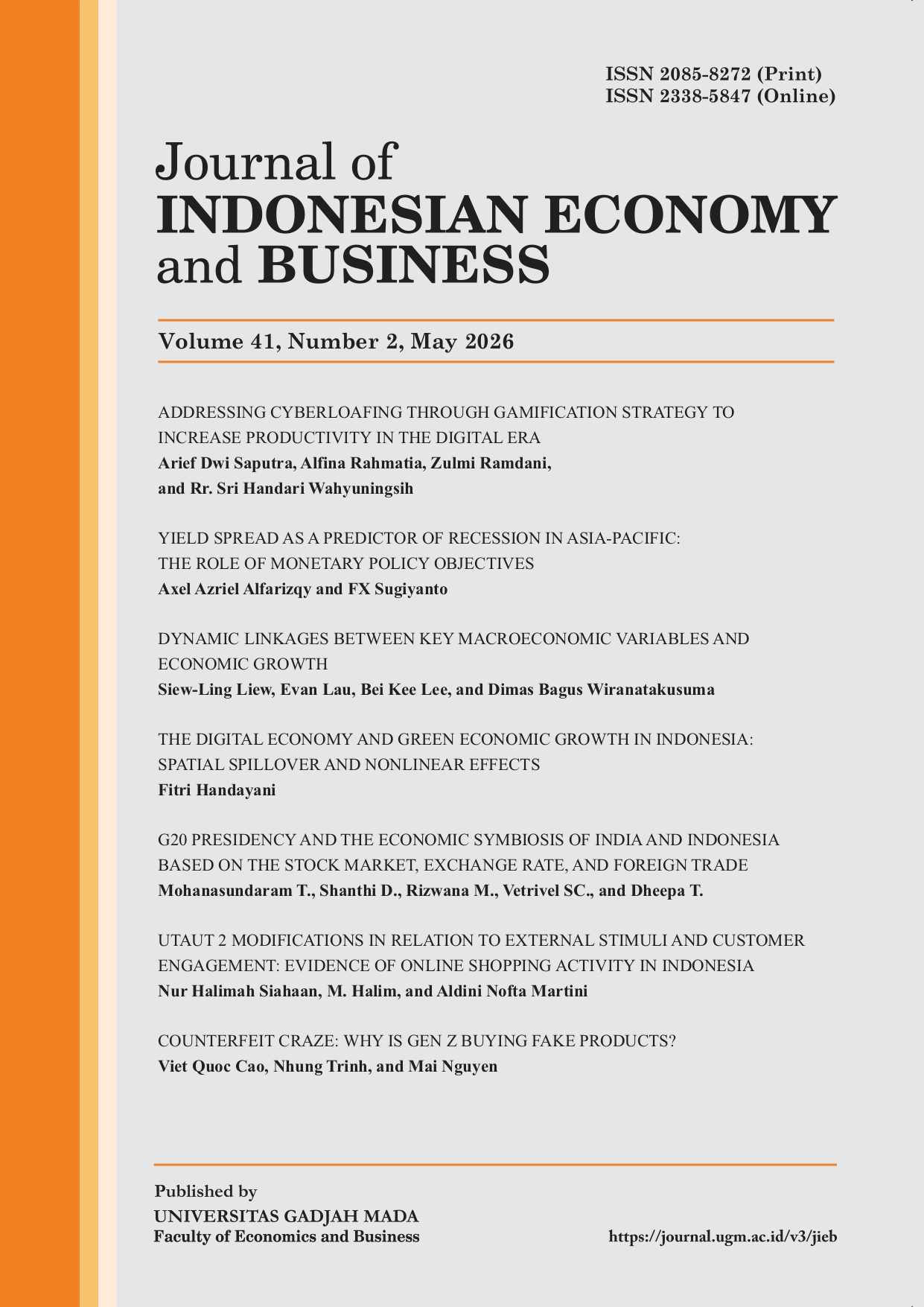
The Digital Economy and Green Economic Growth in Indonesia: Spatial Spillover and Nonlinear Effects
Corresponding Author(s) : Fitri Handayani
Journal of Indonesian Economy and Business,
Vol 41 No 2 (2026): May
Abstract
Introduction/Main Objectives: This study aims to investigate the digital economy and its spatial effects on green economic growth in Indonesia. It also explores nonlinear or U-shaped effects of the digital economy. Background Problem: The research addresses the background problem of balancing economic growth and environmental sustainability, emphasizing the spatial interdependencies in the digital economy's impact on green economic growth. Understanding these spatial effects is crucial for designing effective regional policies. Novelty: The novelty of this study lies in its examination of the impact of the digital economy on green economic growth using an aggregate index constructed using the Entropy value method. Furthermore, spatial effects are incorporated to account for interdependencies among regions. Research Methods: Spatial analysis using the spatial Durbin model with random-effects models is employed to analyze the data. Findings/Results: Empirical findings from this study indicate a negative impact of the digital economy on green economic growth in Indonesia. Moreover, the study confirms the presence of a nonlinear relationship, specifically a U-shaped effect between the digital economy and the environment-economy index. The coefficients of spatial effects, encompassing both the digital economy and green economic growth, demonstrate significant influences on this relationship. Conclusion: Currently, Indonesia finds itself in the early evolutionary stage of digitalization, which has potential to improve the green economy in the longer term. Optimizing the digital economy is imperative to mitigating unsustainable outputs and inputs in the manufacturing process. Furthermore, achieving a sustainable economy necessitates considering the effects of other regions on local green economies, emphasizing the importance of understanding spatial interdependencies.
Keywords
Download Citation
Endnote/Zotero/Mendeley (RIS)BibTeX
- Bilal, Khan, I., Tan, D., Azam, W., & Tauseef Hassan, S. (2022). Alternate energy sources and environmental quality: The impact of inflation dynamics. Gondwana Research, 106, 51–63. https://doi.org/10.1016/j.gr.2021.12.011
- Borojo, D. G., Yushi, J., & Miao, M. (2022). The effects of COVID-19 on trade, production, environmental quality and its implications for green economy. Journal of Economic Studies, 49(8), 1340–1359. https://doi.org/10.1108/JES-06-2021-0307
- Cao, J., Law, S. H., Bin Abdul Samad, A. R., Binti W Mohamad, W. N., Wang, J., & Yang, X. (2022). Effect of financial development and technological innovation on green growth—Analysis based on spatial Durbin model. Journal of Cleaner Production, 365, 132865. https://doi.org/10.1016/j.jclepro.2022.132865
- Chang, X., & Li, J. (2022). Effects of the Digital Economy on Carbon Emissions in China: A Spatial Durbin Econometric Analysis. Sustainability (Switzerland), 14(24). https://doi.org/10.3390/su142416624
- Ciocoiu, C. N. (2011). Integrating digital economy and green economy: opportunities for sustainable development. Theoretical and Empirical Researches in Urban Management, 6(1), 33–43.
- Corrocher, N., & Ordanini, A. (2002). Measuring the digital divide: A framework for the analysis of cross-country differences. Journal of Information Technology, 17(1), 9–19. https://doi.org/10.1080/02683960210132061
- Demartini, M., Evans, S., & Tonelli, F. (2019). Digitalization technologies for industrial sustainability. Procedia Manufacturing, 33, 264–271. https://doi.org/10.1016/j.promfg.2019.04.032
- Fagas, G., Gallagher, J. P., Gammaitoni, L., & Paul, D. J. (2017). Energy Challenges for ICT. In ICT - Energy Concepts for Energy Efficiency and Sustainability (pp. 1–36). InTech.
- Feng, Z., Cheng, S., Qu, G., Cui, Y., & Ye, J. (2023). Research on Theoretical Mechanism and Promotion Path of Digital Economy Driving China’s Green Development under “Double Carbon” Background. Interna¬tional Journal of Environmental Research and Public Health, 20(1). https://doi.org/10.3390/ijerph20010437
- Fu, F. Y., Alharthi, M., Bhatti, Z., Sun, L., Rasul, F., Hanif, I., & Iqbal, W. (2021). The dynamic role of energy security, energy equity and environmental sustainability in the dilemma of emission reduction and economic growth. Journal of Environmental Management, 280(May 2020), 111828. https://doi.org/10.1016/j.jenvman.2020.111828
- Grossman, G. M., & Krueger, A. B. (1991). Environmental Impacts of A North American Free Trade Agreement. Interna-tional Bureau Of Economic Research, 1–39.
- Han, D., & Liu, M. (2022). How Does the Digital Economy Contribute to Regional Green Development in China? Evidence-Based on the Intermediary Effect of Technological Innovation. Sustainability (Switzerland), 14(18), 1–14. https://doi.org/10.3390/su141811147
- Hao, X., Li, Y., Ren, S., Wu, H., & Hao, Y. (2023). The role of digitalization on green economic growth: Does industrial structure optimization and green innovation matter? Journal of Environmental Management, 325, 116504. https://doi.org/10.1016/j.jenvman.2022.116504
- Hilty, L. M., Arnfalk, P., Erdmann, L., Goodman, J., Lehmann, M., & Wäger, P. A. (2006). The relevance of information and communication technologies for environ¬mental sustainability - A prospective simulation study. Environmental Modelling and Software, 21(11), 1618–1629. https://doi.org/10.1016/j.envsoft.2006.05.007
- Hook, A., Court, V., Sovacool, B. K., & Sorrell, S. (2020). A systematic review of the energy and climate impacts of teleworking. Environmental Research Letters, 15(9). https://doi.org/10.1088/1748-9326/ab8a84
- Ihsanudin, I., & Rahayu, A. Y. S. (2019). Collaborative Innovation in Digital Ecosys¬tem. The 1st International Conference on Emerging Media, and Social Science, ICEMSS. https://doi.org/10.4108/eai.7-12-2018.2281772
- Imansyah, M. H., Hartono, D., Putranti, T., & Muzdalifah. (2023). The Impacts of Digital Economy on Green Economy: The Indonesian Miyazawa Model. Polish Journal of Environmental Studies, 32(2), 1609–1619. https://doi.org/10.15244/pjoes/159123
- Islam, A. A. A., Trinugroho, I., & Suryanto. (2023). Smes’ Flight To Digital and Green Economy: Evidence From Indonesia. International Journal of Business and Society, 24(1), 362–379. https://doi.org/10.33736/ijbs.5622.2023
- Jiao, J., Yang, Y., & Bai, Y. (2018). The impact of inter-industry R&D technology spillover on carbon emission in China. Natural Hazards, 91(3), 913–929. https://doi.org/10.1007/s11069-017-3161-3
- Jovane, F., Yoshikawa, H., Alting, L., Boër, C. R., Westkamper, E., Williams, D., Tseng, M., Seliger, G., & Paci, A. M. (2008). The incoming global technological and industrial revolution towards competitive sustainable manufacturing. CIRP Annals - Manufacturing Technology, 57(2), 641–659. https://doi.org/10.1016/j.cirp.2008.09.010
- Kong, Q., Li, R., Ni, Y., & Peng, D. (2022). Does China’s green economic recovery generate a spatial convergence trend: an explanation using agglomeration effects and fiscal instruments. Economic Change and Restructuring, 55(4), 2499–2526. https://doi.org/10.1007/s10644-022-09396-2
- Lange, S., Pohl, J., & Santarius, T. (2020). Digitalization and energy consumption. Does ICT reduce energy demand? Ecologi¬cal Economics Journal, 176, 106760.
- LeSage, J., & Pace, R. K. (2009). Introduction: Spatial Econometrics. In Chapman and Hall. Non-standard Spatial Statistics and Spatial Econometrics. Advances in Geographic Information Science (AGIS, Vol 1). Springer. https://doi.org/10.4000/rei.3887
- Liu, R., Wang, D., Zhang, L., & Zhang, L. (2019). Can green financial development promote regional ecological efficiency ? A case study of China. Natural Hazards, 95(1), 325–341. https://doi.org/10.1007/s11069-018-3502-x
- Luo, K., Liu, Y., Chen, P., Zeng, M., (2022). Assessing the impact of digital economy on green development effciency in the Yangtze River Economic Belt. Energy Economics, 112, 106127. https://doi.org/10.1016/j.eneco.2022.106127
- Ma, D., & Zhu, Q. (2022). Innovation in emerging economies : Research on the digital economy driving high-quality green development. Journal of Business Research, 145, 801–813. https://doi.org/10.1016/j.jbusres.2022.03.041
- Midden, C., Mccalley, T., Ham, J., & Zaalberg, R. (2008). Using persuasive technology to encourage sustainable behavior. Workshop Paper at 6th International Conference on Pervasive Computing, 1, 83–86.
- Nukusheva, A.; Ilyassova, G.; Rustembekova, D.; Zhamiyeva, R.; Arenova, L. (2021). Global Warming Problem Faced by the International Community: International Legal Aspect. Int. Environ. Agreem. Polit. Law Econ, 21, 219–233.
- OECD. (2020). Roadmap toward A Common Framework for Measuring the Digital Economy. OECD Publishing.
- Pirciog, S. C., Grigorescu, A., Lincaru, C., Popa, F. M., Lazarczyk Carlson, E., & Sigurdarson, H. T. (2023). Mapping European high-digital intensive sectors—regional growth accelerator for the circular economy. Frontiers in Environmental Science, 10(January), 1–16. https://doi.org/10.3389/fenvs.2022.1061128
- Ratner, B. (2009). The correlation coefficient: Its values range between + 1 / − 1, or do they ? Journal of Targeting, Measurement and Analysis for Marketing, 17(2), 139–142.
- Romer, P M. (1990). Endogenous Technological Change. Journal of Political Economy, 98(5), 71-102.
- Rumata, V. M., & Sastrosubroto, A. S. (2021). The paradox of Indonesian digital economy development. In R. M. X. Wu and M. Mircea (Eds.), E-Business: Higher Educa¬tion and Intelligence Applications (pp. 33–46). https://www.intechopen.com/chapters/72266
- Solow, R. M. (1957). Technical Change and the Aggregate Production Function Author ( s ): Robert M . Solow Source : The Review of Economics and Statistics. The Review of Economics and Statistics, 39(3), 312–320.
- Solow, R. (1991). Sustainability: An Econo-mist’s perspective. The eighteenth J. Seward Johnson lecture. Woods Hole, MA: Woods Hole Oceanographic Institution.
- Tang, L., Lu, B., & Tian, T. (2023). The Effect of Input Digitalization on Carbon Emission Intensity: An Empirical Analysis Based on China’s Manufacturing. International Journal of Environmental Research and Public Health, 20(4), 1–22. https://doi.org/10.3390/ijerph20043174
- Tawiah, V., Zakari, A., & Adedoyin, F. F. (2021). Determinants of green growth in developed and developing countries. Environmental Science and Pollution Research, 28(29), 39227–39242. https://doi.org/10.1007/s11356-021-13429-0
- Ullah, S., Apergis, N., Usman, A., & Chishti, M. Z. (2020). Asymmetric effects of inflation instability and GDP growth volatility on environmental quality in Pakistan. Envi¬ronmental Science and Pollution Research, 27(25), 31892–31904. https://doi.org/10.1007/s11356-020-09258-2
- Valenduc, G., & Vendramin, P. (2016). Work in the digital economy : sorting the old from the new (Working Papers - European Trade-Union Institute (ETUI)).
- Vishnevsky, V. P., Harkushenko, O. M., Zanizdra, M. Y., & Kniaziev, S. I. (2021). Digital and green economy : common grounds and contradictions. Science and Innovation, 17(3), 14–27. https://doi.org/10.15407/scine17.03.014
- Wang, W., Yang, X., Cao, J., Bu, W., Dagestani, A. A., Adebayo, T. S., Dilanchiev, A., & Ren, S. (2022). Energy internet, digital economy, and green economic growth: Evidence from China. Innovation and Green Development, 1, 100011. https://doi.org/10.1016/j.igd.2022.100011
- Wang, Z., Wang, X., & Liang, L. (2019). Green economic efficiency in the Yangtze River Delta: spatiotemporal evolution and influencing factors. Ecosystem Health and Sustainability, 5(1), 20–35. https://doi.org/10.1080/20964129.2018.1559000
- Xiang, X., Yang, G., & Sun, H. (2022). The Impact of the Digital Economy on Low‐Carbon, Inclusive Growth: Promoting or Restraining. Sustainability (Switzerland), 14(12), 1–27. https://doi.org/10.3390/su14127187
- Xu, S., Yang, C., Huang, Z., & Failler, P. (2022). Interaction between Digital Economy and Environmental Pollution: New Evidence from a Spatial Perspective. International Journal of Environmental Research and Public Health, 19(9). https://doi.org/10.3390/ijerph19095074
- Yang, T., Zhou, K., & Zhang, C. (2022). Spatiotemporal patterns and influencing factors of green development efficiency in China’s urban agglomerations. Sustainable Cities and Society, 85(April), 104069. https://doi.org/10.1016/j.scs.2022.104069
- Zhang, J., Lyu, Y., Li, Y., Geng, Y. (2022) Digital economy: An innovation driving factor for low-carbon development. Environmental Impact Assessment Review, 96, 106821. https://doi.org/10.1016/j.eiar.2022.106821
- Zhao, S., Jiang, Y., & Wang, S. (2019). Innovation stages, knowledge spillover, and green economy development: moderating role of absorptive capacity and environ¬mental regulation. Environmental Science and Pollution Research, 26(24), 25312–25325. https://doi.org/10.1007/s11356-019-05777-9
- Zhong, K., Fu, H., & Li, T. (2022). Can the Digital Economy Facilitate Carbon Emissions Decoupling? An Empirical Study Based on Provincial Data in China. International Journal of Environmental Research and Public Health, 19(11). https://doi.org/10.3390/ijerph19116800