


 * Corresponding Author


Yield gap analysis between irrigated and rainfed rice agroecosystem
 https://doi.org/10.22146/ipas.97040
 Handoko Handoko(1*), Budiastuti Kurniasih(2), Taryono Taryono(3)
(1) Department of Agronomy, Faculty of Agriculture, Universitas Gadjah Mada
(2) Department of Agronomy, Faculty of Agriculture, Universitas Gadjah Mada
(3) Department of Agronomy, Faculty of Agriculture, Universitas Gadjah Mada
(*) Corresponding Author
Abstract
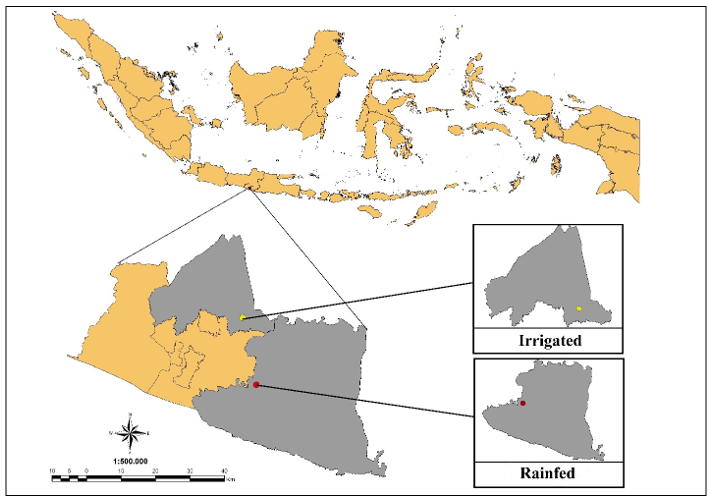
Rice is an essential crop for worldwide food security, providing the primary feeding for nearly half of the people on earth. In order to meet the increasing demand for rice, it is necessary to reduce the yield gap between irrigated and rainfed rice agroecosystem; therefore, a descriptive approach is used to estimate the yield gap (Yg) between irrigated (Yp) and rainfed rice agroecosystems (Yw) and identify its key factors. This research aimed to identify the causes of the yield gap between irrigated and rainfed rice agroecosystems and evaluate the causes of the yield gap so as to minimize the yield gap. This research had been conducted from December 2021 to April 2022 in two different locations, an irrigated and a rainfed rice agroecosystem (planted between M. cajuputi stands). Fourteen genotypes were grown in a complete randomized block design consisting of three blocks in each location (irrigated and rainfed rice fields). The experimental unit at each research location was 20 m² (4 m × 5 m), and the harvest area was 12 m² (3 m × 4 m), consisting of 192 populations of rice plants. The results showed that soil fertility limiting factors, including total nitrogen, phosphorus and available potassium caused the yield gap. The maximum yield recorded was in G2 (8.83 ton.ha⁻¹) in the irrigated agroecosystem, while the minimum yield was in G8 (0.64 ton.ha⁻¹) in the rainfed agroecosystem. Yield gap analysis revealed a gap of 5.27 ton.ha⁻¹ between the irrigated and rainfed systems. The most significant yield gap was observed in G3 at (6.92 ton.ha⁻¹), whereas the least was in G10 (3.17 ton.ha⁻¹). The genotype G2, exhibiting the highest yield in the irrigated agroecosystem, is recommended for planting, while G4, with a potential yield of 4.14 ton.ha⁻¹, is suggested for rainfed agroecosystems.
Keywords
Full Text:
PDFReferences
Affholder, F., Poeydebat, C., Corbeels, M., Scopel, E. and Tittonell, P. (2013). The yield gap of major food crops in family agriculture in the tropics: Assessment and analysis through field surveys and modelling. Field Crops Research, 143, pp. 106–118.
Alam, T., Suryanto, P., Nurmalasari, A.I., and Kurniasih, B. (2019) GGE-Biplot Analysis for Soybean Varieties Suitability in an Agroforestry System based on Kayu Putih Stands. Caraka Tani: Journal of Sustainable Agriculture, 34(2), pp. 213−222.
Aristya, V.E., Taryono, Trisyono, Y.A. and Mulyo, J.H. (2021). Morphological Fingerprint of New Rice Genotypes. IOP Conference Series: Earth and Environmental Science, 662(1), pp. 1–2.
Balemi, T., and Negisho, K. (2012). Management of soil phosphorus and plant adaptation mechanisms to phosphorus stress for sustainable crop production: a review. Journal of soil science and plant nutrition, 12(3), 547–562.
Bouyoucos, G.J. (1962). Hydrometer Method Improved for Making Particle Size Analyses of Soils 1. Agronomy Journal, 54(5), pp. 464–465.
Bremner, J.M. and Mulvaney, C.S. (1982) Nitrogen-Total. In: Page, A.L., Ed., Methods of Soil Analysis. Part 2. Chemical and Microbiological Properties, American Society of Agronomy, Soil Science Society of America, pp. 595−624.
Debnath, S., Mishra, A., Mailapalli, D.R., Raghuwanshi, N.S. and Sridhar, V. (2021). Assessment of rice yield gap under a changing climate in India. Journal of Water and Climate Change, 12(4), pp. 1245–1267.
Dengiz, O., Saglam, M., Sarioglu, F.E., Saygin, F. and Atasoy, C. (2012). Morphological and Physico-Chemical Characteristics and Classification of Vertisol Developed on Deltaic Plain. Open Journal of Soil Science, 02(01), pp. 20–27.
Dissanayaka, D.M.S.B., Nishida, S., Tawaraya, K., and Wasaki, J. (2018). Organ-specific allocation pattern of acquired phosphorus and dry matter in two rice genotypes with contrasting tolerance to phosphorus deficiency. Soil Science and Plant Nutrition, 64(3), pp. 282–290.
Dobermann, A., Cassman, K. G., and Walters, D. T. (2013). Fertilizer best management practices. In IFA (International Fertilizer Association). Fertilizer and Climate Change Mitigation. Paris, France: IFA, pp. 29–41.
Dossou-Yovo, E.R., Vandamme, E., Dieng, I., Johnson, J.M., and Saito, K. (2020). Decomposing rice yield gaps into efficiency, resource and technology yield gaps in sub-Saharan Africa. Field Crops Research, 258, 107963.
FAO. (2014). World reference base for soil resources 2014. International soil classification system for naming soils and creating legends for soil maps.
FAO. (2024). GIEWS global information and early warning system on food and agriculture GIEWS Country Brief The Republic of Indonesia.
Fageria, N. K., Baligar, V. C., and Jones, C. A. (2010). Growth and Mineral Nutrition of Field Crops. 3rd Edition. CRC Press. Boca Raton.
Foley, J.A., Ramankutty, N., Brauman, K.A., Cassidy, E.S., Gerber, J.S., Johnston, M., Mueller, N.D., O’Connell, C., Ray, D.K., West, P.C., Balzer, C., Bennett, E.M., Carpenter, S.R., Hill, J., Monfreda, C., Polasky, S., Rockström, J., Sheehan, J., Siebert, S., Tilman, D., and Zaks, D.P.M. (2011). Solutions for a cultivated planet. Nature, 478(7369), pp. 337–342.
Gupta, R., and Mishra, A. (2019). Climate change induced impact and uncertainty of rice yield of agro-ecological zones of India. Agricultural Systems, 173, pp. 1–11.
Jagadish, S. V. K., Craufurd, P. Q., and Wheeler, T. R. (2007). High temperature stress and spikelet fertility in rice. Journal of Experimental Botany, 58(7), 1627–1635.
Hajjarpoor, A., Soltani, A., Zeinali, E., Kashiri, H., Aynehband, A., and Vadez, V. (2018). Using boundary line analysis to assess the on-farm crop yield gap of wheat. Field Crops Research, 225, pp. 64–73.
Haefele, S. M., Kato, Y., and Singh, S. (2009). Soil fertility and nutrient management in rainfed lowland rice systems. Field Crops Research, 111(1-2), pp. 1–9.
Irfan, M., Aziz, T., Maqsood, M.A., Bilal, H.M., Siddique, K.H.M. & Xu, M. (2020). Phosphorus (P) use efficiency in rice is linked to tissue-specific biomass and P allocation patterns. Scientific Reports, 10(1), p. 4278.
Ittersum, M.K. van, Cassman, K.G., Grassini, P., Wolf, J., Tittonell, P. & Hochman, Z. (2013). Yield gap analysis with local to global relevance—A review. Field Crops Research, 143, pp. 4–17.
Jaramillo, S., Graterol, E. & Pulver, E. (2020). Sustainable Transformation of Rainfed to Irrigated Agriculture Through Water Harvesting and Smart Crop Management Practices. Frontiers in Sustainable Food Systems, 4, pp. 1–11.
Ji, K., Wang, Y., Sun, W., Lou, Q., Mei, H., Shen, S. & Chen, H. (2012). Drought-responsive mechanisms in rice genotypes with contrasting drought tolerance during reproductive stage. Journal of Plant Physiology, 169(4), pp. 336–344.
Karlen, D.L., Andrews, S.S. & Doran, J.W. (2001). Soil quality: current concepts and applications. Advances in Agronomy, 74, pp. 1–40.
Kishné, A.Sz., Morgan, C.L.S. & Miller, W.L. (2009). Vertisol crack extent associated with gilgai and soil moisture in the Texas Gulf Coast Prairie. Soil Science Society of America Journal, 73(4), pp. 1221–1230.
Klinsawang, S., Sumranwanich, T., Wannaro, A. & Saengwilai, P. (2018). Effect of root hair length on potassium acquisition in rice (Oryza sativa L.). Applied Ecology and Environmental Research, 16(2), pp. 1609–1620.
Kovda, I. (2020). Vertisols: Extreme features and extreme environment. Geoderma Regional, 22, pp. 1–12.
Kumar Kujur, V., Sao, A., Singh, M. & Tiwari, A. (2023). Genetic variability, heritability and association analyses for yield and related characters in rice germplasm (Oryza sativa L.). The Pharma Innovation Journal, 12(4), pp. 2236–2240.
V. Visha Kumari, S.S. Balloli, Manoranjan Kumar, D.B.V. Ramana, M. Prabhakar, M. Osman, A.K. Indoria, M. Manjunath, V. Maruthi, G. Ravindra Chary, M.A. Sarath Chandran, K.A. Gopinath, G. Venkatesh, M.S. Rao, V.K. Singh, J. Timsina. (2024). Diversified cropping systems for reducing soil erosion and nutrient loss and for increasing crop productivity and profitability in rainfed environments. Agricultural Systems, 217, pp. 1-14.
Lampayan, R.M., Rejesus, R.M., Singleton, G.R. & Bouman, B.A.M. (2015). Adoption and economics of alternate wetting and drying water management for irrigated lowland rice. Field Crops Research, 170, pp. 95–108.
Lestariningsih, I.D., Widianto & Hairiah, K. (2013). Assessing Soil Compaction with Two Different Methods of Soil Bulk Density Measurement in Oil Palm Plantation Soil. Procedia Environmental Sciences, 17, pp. 172–178.
Li, D., Nanseki, T., Chomei, Y. & Yokota, S. (2018). Production efficiency and effect of water management on rice yield in Japan: two-stage DEA model on 110 paddy fields of a large-scale farm. Paddy and Water Environment, 16(4), pp. 643–654.
Li, G., Zhang, J., Yang, C., Song, Y., Zheng, C., Wang, S., Liu, Z. & Ding, Y. (2014). Optimal yield-related attributes of irrigated rice for high yield potential based on path analysis and stability analysis. The Crop Journal, 2(4), pp. 235–243.
Licker, R., Johnston, M., Foley, J.A., Barford, C., Kucharik, C.J., Monfreda, C. & Ramankutty, N. (2010). Mind the gap: how do climate and agricultural management explain the “yield gap” of croplands around the world?. Global Ecology and Biogeography, 19(6), pp. 769–782.
Liu, Q., WU, X., CHEN, B., MA, J. & GAO, J. (2014). Effects of Low Light on Agronomic and Physiological Characteristics of Rice Including Grain Yield and Quality. Rice Science, 21(5), pp. 243–251.
Lobell, D.B., Cassman, K.G. & Field, C.B. (2009). Crop Yield Gaps: Their Importance, Magnitudes, and Causes. Annual Review of Environment and Resources, 34(1), pp. 179–204.
Lorenz, K. & Lal, R. (2014). Soil organic carbon sequestration in agroforestry systems. A review. Agronomy for Sustainable Development, 34(2), pp. 443–454.
Lynch, J. P. (2011). Root phenes for enhanced soil exploration and phosphorus acquisition: tools for future crops. Plant Physiology, 156(3), pp. 1041–1049.
Mondal, M.H. (2011). Causes of yield gaps and strategies for minimizing the gaps in different crops of Bangladesh. Bangladesh J. Agril. Res, 36(3), pp. 469–476.
Mueller, N.D., Gerber, J.S., Johnston, M., Ray, D.K., Ramankutty, N. & Foley, J.A. (2012). Closing yield gaps through nutrient and water management. Nature, 490(7419), pp. 254–257.
Nadif, R.N., Kastono, D., Handayani, S. & Alam, T. (2021). Pengaruh model pemanenan air hujan terhadap pertumbuhan dan hasil empat kultivar padi dalam sistem agroforestri dengan kayu putih pada musim hujan. Vegetalika, 10(4), pp. 223–234.
Nhamo, N., Rodenburg, J., Zenna, N., Makombe, G. & Luzi-Kihupi, A. (2014). Narrowing the rice yield gap in East and Southern Africa: Using and adapting existing technologies. Agricultural Systems, 131, pp. 45–55.
Nyabami, P., Weinrich, E., Maltais‐Landry, G. & Lin, Y. (2024). Three years of cover crops management increased soil organic matter and labile carbon pools in a subtropical vegetable agroecosystem. Agrosystems, Geosciences & Environment, 7(1), pp. 1–14.
Olorunfemi, I., Fasinmirin, J. & Ojo, A. (2016). Modeling cation exchange capacity and soil water holding capacity from basic soil properties. Eurasian Journal of Soil Science (EJSS), 5(4), p. 266.
Panda, D., Mohanty, S., Das, S., Mishra, B., Baig, M.J. & Behera, L. (2023). Light intensity–mediated auxin homeostasis in spikelets links carbohydrate metabolism enzymes with grain filling rate in rice. Protoplasma, 260(4), pp. 1233–1251.
Peniwiratri, L., Saidi, D. & Solikhin, C.M. (2020). Response to availability of N regosol and its uptake by tomatoes on giving gamal (Gliricidia sepium) at different times. Yogyakarta Conference Series Proceeding on Engineering and Science Series (ESS), 1(1), pp. 461–467.
Phengphaengsy, F. & Okudaira, H. (2008). Assessment of irrigation efficiencies and water productivity in paddy fields in the lower Mekong River Basin. Paddy and Water Environment, 6(1), pp. 105–114.
Ran, Y., Chen, H., Ruan, D., Liu, H., Wang, S., Tang, X. & Wu, W. (2018). Identification of factors affecting rice yield gap in southwest China: An experimental study. PLOS ONE, 13(11), pp. 1–15.
Saketh, T., Shankar, V.G., Srinivas, B. & Hari, Y. (2023). Correlation and Path Coefficient Studies for Grain Yield and Yield Components in Rice (Oryza sativa L.). International Journal of Plant & Soil Science, 35(19), pp. 1549–1558.
Suryanto, P., Taryono., Supriyanta., Kastono, D., Putra, E.T.S., Handayani, S., Widyawan, M.H. & Alam, T. (2020). Assessment of soil quality parameters and yield of rice cultivars in Melaleuca cajuputi agroforestry system. Biodiversitas Journal of Biological Diversity, 21(8), pp. 3463–3470.
Swain, P., Raman, A., Singh, S.P. & Kumar, A. (2017). Breeding drought tolerant rice for shallow rainfed ecosystem of eastern India. Field Crops Research, 209, pp. 168–178.
Tan, B.T., Fam, P.S., Firdaus, R.B.R., Tan, M.L. & Gunaratne, M.S (2021). Impact of climate change on rice yield in Malaysia: A panel data analysis. Agriculture, 11(6), p. 569.
Taryono, Suryanto, P., Supriyanta, Basunanda, P., Wulandari, R.A., Handayani, S., Nurmansyah & Alam, T. (2022). Soybean crop rotation stability in rainfed agroforestry system through GGE biplot and EBLUP. Agronomy, 12(9), pp. 1–16.
Taryono, T., Supriyanta, S., Wulandari, R.A., Nurmansyah, N., Ambarwati, E., Arsana, I.G.K.D., Aristya, V.E., Purba, A.E., Aisya, A.W. & Alam, T. (2023). Selection of drought-tolerant rice genotypes under cajuput (Melaleuca cajuputi subsp. cajuputi) agroforestry system. Biodiversitas Journal of Biological Diversity, 24(9), pp. 4791–4802.
Tuong, T.P., Kam, S.P., Wade, L.S., Bouman, B.A.M. & Hardy, B. (2000). Characterizing and understanding rainfed environments, IRRI.
Tuong, T. P., & Bouman, B. A. M. (2003). Rice production in water-scarce environments. In: Water Productivity in Agriculture: Limits and Opportunities for Improvement. CABI Publishing.
USDA, 2012, Field Book for Describing and Sampling Soils; Version 3.0; 2021 Reprint.
Vanlauwe, B., Chianu, J., Giller, K.E., MerckxC, R., Mokwunye, U., Pypers, P., Shepherd, K., Smaling, E., Woomer, P.L., and Sanginga, N. (2010). Integrated soil fertility management: Operational definition and consequences for implementation and dissemination. Outlook on Agriculture, 39(1), pp. 17–24.
Vogelmann, E.S., Reichert, J.M., Reinert, D.J., Mentges, M.I., Vieira, D.A., Barros, C.A.P. de & Fasinmirin, J.T. (2010). Water repellency in soils of humid subtropical climate of Rio Grande do Sul, Brazil. Soil and Tillage Research, 110(1), pp. 126–133.
Voltr, V., Menšík, L., Hlisnikovský, L., Hruška, M., Pokorný, E. & Pospíšilová, L. (2021). The soil organic matter in connection with soil properties and soil inputs. Agronomy, 11(4), p. 779.
Wan, L., Cen, H., Zhu, J., Zhang, J., Zhu, Y., Sun, D., Du, X., Zhai, L., Weng, H., Li, Y., Li, X., Bao, Y., Shou, J. & He, Y. (2020). Grain yield prediction of rice using multi-temporal UAV-based RGB and multispectral images and model transfer – a case study of small farmlands in the South of China. Agricultural and Forest Meteorology, 291, pp. 1–15.
Xu, Q., Chen, W. & Xu, Z. (2015). Relationship between grain yield and quality in rice germplasms grown across different growing areas. Breeding Science, 65(3), pp. 226–232.
Yang, B., Tang, J., Yu, Z., Khare, T., Srivastav, A., Datir, S. & Kumar, V. (2019). Light stress responses and prospects for engineering light stress tolerance in crop plants. Journal of Plant Growth Regulation, 38(4), pp. 1489–1506.
Yang, P.M., Huang, Q.C., Qin, G.Y., Zhao, S.P. & Zhou, J.G. (2014). Different drought-stress responses in photosynthesis and reactive oxygen metabolism between autotetraploid and diploid rice. Photosynthetica, 52(2), pp. 193–202.
Zeigler, R.S. & Barclay, A. (2008). The relevance of rice. Rice, 1(1), pp. 3–10.
Zhang, T., He, X., Chen, B., He, L. & Tang, X. (2021). Effects of different potassium (K) fertilizer rates on yield formation and lodging of rice. Phyton, 90(3), pp. 815–826.
Zhao, H., Mo, Z., Lin, Q., Pan, S., Duan, M., Tian, H., Wang, S. & Tang, X. (2020). Relationships between grain yield and agronomic traits of rice in southern China. Chilean journal of agricultural research, 80(1), pp. 72–79.
DOI: https://doi.org/10.22146/ipas.97040
Article Metrics
 Abstract views : 1733
|
Abstract views : 1733
|  views : 914
Refbacks
- There are currently no refbacks.


_2025_-_kecil_.png)
_2024_kecil_2.png)
Upcoming Issues :
-

Ilmu Pertanian (Agricultural Science) ISSN 0126-4214 (print), ISSN 2527-7162 (online) is published by Faculty of Agriculture Universitas Gadjah Mada collaboration with Perhimpunan Sarjana Pertanian Indonesia (PISPI) and licensed under a Creative Commons Attribution-ShareAlike 4.0 International License.