


 * Corresponding Author


Cow Manure for Improving Carbon-to-Nitrogen Ratio of Tailings, Growth, and Biomass of Water Kale (Ipomoea reptans Poir.)
 https://doi.org/10.22146/ipas.106456
 Reginawanti Hindersah(1*), Zahra Ardelia(2), Emma Trinurani Sofyan(3), Ade Setiawan(4), Farida Damayanti(5)
(1) Universitas Padjadjaran
(2) Universitas Padjadjaran
(3) Universitas Padjadjaran
(4) Universitas Padjadjaran
(5) Universitas Padjadjaran
(*) Corresponding Author
Abstract
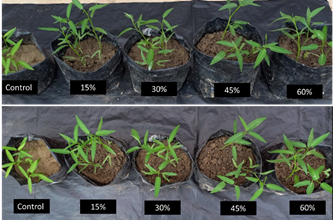
Gold mine tailings are characterized by low organic matter, poor nutrient availability, extreme pH conditions, and unfavorable texture, all of which restrict plant growth. This study evaluated the effects of cow manure (CM) on soil chemical properties, carbon-to-nitrogen (C/N) ratio, and the growth and biomass of water kale (Ipomoea reptans Poir.) cultivated in tailings-based media. A greenhouse experiment was arranged in a randomized block design consisting of five treatments: 0% (control), 15%, 30%, 45%, and 60% CM (v/v), each replicated six times. Observations included soil pH, organic carbon, total nitrogen, C/N ratio, plant growth parameters, biomass, and microbial populations at 35 days after planting. The application of CM significantly increased organic C, total N, and the C/N ratio, with the highest values observed at 60% CM. However, higher CM doses reduced substrate pH to slightly acidic levels. The 15% CM treatment produced the greatest improvements in plant growth and biomass, increasing plant height by 21%, stem thickness by 29%, leaf number by 8%, and fresh and dry biomass by 73% and 120%, respectively, compared with the control. Increasing CM above 15% enhanced the C/N ratio but did not further improve plant performance, likely due to reduced nitrogen availability associated with higher organic matter and slower mineralization. CM applications did not significantly affect bacterial or fungal populations in the rhizosphere. Overall, the findings indicate that low-dose CM (15%) is optimal for improving the C/N ratio, supporting nutrient availability, and enhancing water kale growth in tailings. This study demonstrates the potential of organic amendments for rehabilitating gold mine tailings and highlights their role in restoring soil functionality and supporting sustainable revegetation efforts.
Keywords
Full Text:
PDFReferences
Abbasi, M. K., Tahir, M. M., Sabir, N. and Khurshid, M. (2015). Impact of the addition of different plant residues on nitrogen mineralization–immobilization turnover and carbon content of a soil incubated under laboratory conditions. Solid Earth, 6(1), pp. 197–205. doi: 10.5194/se-6-197-2015.
Alori, E. T., Olaniyan, F. T., Adekiya, A. O., Ayorinde, B. B., Daramola, F. Y., Joseph, A., Adegbite, K. A., Ibaba, A. L., Aremu, C. O. and Babalola, O. O. (2023). Response of soil microbial community (bacteria and fungi) to organic and inorganic amendments using tomato as a test crop. Air, Soil and Water Res., 16. doi: 10.1177/11786221231214063.
Arranz-González, J. C., and Cala-Rivero, V. (2017). Grain sorting effects on geochemical characteristics of sulfide mine tailings: a case study. Journal of Degraded Mining and Lands Management, 4(3), pp. 767–780. doi: 10.15243/jdmlm.2017.043.767.
Association of Official Agricultural Chemists. (2019) Official Methods of Analysis of AOAC International. 21th Edition. Edited by G. W. Latimer. Maryland: AOAC International.
Bai, X., Tang, J., Wang, W., Ma, J., Shi, J. and Ren, W. (2023). Organic amendment effects on cropland soil organic carbon and its implications: A global synthesis. CATENA, 231, p 107343, https://doi.org/10.1016/j.catena.2023.107343.
Baiyeri, P., Otitoju, G.T.O., Abu, N. E. and Umeh, S. (2016). Poultry manure influenced growth, yield and nutritional quality of containerized aromatic pepper (Capsicum annuum L., var Nsukka Yellow). African Journal of. Agricultural Research, 11(23), pp. 2013-2023. DOI: 10.5897/AJAR2015.10512.
Bailey-Serres, J., Fukao, T., Gibbs, D. J., Holdsworth, M. J., Lee, S. C., Licausi, F., Perata, P., Voesenek, L. A. C. J. and van Dongen, J. T. (2012). Making sense of low oxygen sensing. Trends in Plant Science, 17(3), pp. 129–138. doi: 10.1016/j.tplants.2011.12.004.
Ben-David, A., and Davidson, C. E. (2014). Estimation method for serial dilution experiments. Journal of Microbiological Methods, 107, pp. 214–221. doi: 10.1016/j.mimet.2014.08.023.
Bielczynski, L.W., Łącki, M.K., Hoefnagels, I., Gambin, A. and Croce, R. (2017). Leaf and plant age affects photosynthetic performance and photoprotective Capacity. Plant Physiology, 175(4):1634–1648. doi: 10.1104/pp.17.00904
Briffa, J., Sinagra, E. and Blundell, R. (2020). Heavy metal pollution in the environment and their toxicological effects on humans. Heliyon, 6(9), p.e04691. doi: 10.1016/j.heliyon.2020.e04691.
Camenzind, T., Grenz, K. P., Lehmann, J. and Rillig, M.C. (2021). Soil fungal mycelia have unexpectedly flexible stoichiometric C:N and C:P ratios. Ecological Letters, 24(2), pp. 208–218. doi: 10.1111/ele.13632.
Chen, J., Du, Y., Zhu, W., Pang, X. and Wang, Z. (2022). Effects of organic materials on soil bacterial community structure in long-term continuous cropping of tomato in greenhouse, Open Life Science, 17(1), pp. 381–392. doi: 10.1515/biol-2022-0048.
Dewi, T., Sukarjo, S., Handayani, C. O., Hindersah, R., Waas, E. D., Kalay, A. M. and Zu’amah, H. (2023). The potential of legume cover crops and soil microbes for gold mine tailings revegetation. Journal of Degraded Mining and Lands Management, 10(4), pp. 4593–4600. doi: 10.15243/jdmlm.2023.104.4593.
Ditjen Minerba. (2012). Menyusuri jejak gurandil di tambang emas Pongkor, Kementerian Energi dan Sumber Daya Mineral. [online]. Available at https://www.minerba.esdm.go.id/berita/minerba/detil/20121013-menyusuri-jejak-gurandil-di-tambang-emas-pongkor (Accessed: 18 June 2024).
Gawol, D., Nichvolodoff, T. and Floyd, R. (2022). Carbon to nitrogen ratios influence microbial diversity in the soil of interior Douglas-fir forests in British Columbia, Undergraduate Journal of Experimental Microbiology and Immunology, 27, pp. 1–12.
Gallegos-Cedillo, V.M., Diánez, F., Nájera, C. and Santos, M. (2021). Plant agronomic features can predict quality and field performance: A bibliometric analysis. Agronomy, 11(11), pp. 2305; https://doi.org/10.3390/agronomy11112305
Hadas, A., Kautsky, L., Goek, M. and Kara, E.E. (2004). Rates of decomposition of plant residues and available nitrogen in soil, related to residue composition through simulation of carbon and nitrogen turnover. Soil Biology and Biochemistry, 36(2), pp. 255-266.
Hasan, F. and Pakaya, N. (2020). Perbedaan jenis komposisi media tanam terhadap pertumbuhan dan produksi kangkung darat (Ipomea reptans Poir) dalam polibag. Jurnal Agercolere, 2(1), pp. 17–23. doi: 10.37195/jac.v2i1.101.
Hindersah, R., Risamasu, R., Kalay, A. M., Dewi, T. and Makatita, I. (2018a). Mercury contamination in soil, tailings, and plants on agricultural fields near closed gold mine in Buru Island, Maluku. Journal of Degraded Mining and Lands Management, 5(2), pp. 1027–1034. doi: 10.15243/jdmlm.2018.052.1027.
Hindersah, R., Handyman, Z., Indriani, F. N., Suryatamana, P. and Nurlaeny, N. (2018b). Azotobacter population, soil nitrogen and groundnut growth in mercury-contaminated tailing inoculated with Azotobacter. Journal of Degraded Mining and Lands Management, 5(3), pp. 1269–1274. doi: 10.15243/jdmlm.2018.053.1269
Jiang, M., Dong, C., Bian, W., Zhang, W. and Wang, Y. (2024). Effects of different fertilization practices on maize yield, soil nutrients, soil moisture, and water use efficiency in northern China based on a meta-analysis, Scientific Reports, 14(1), p. 6480. doi: 10.1038/s41598-024-57031-z.
Klopp, H. (2024) Carbon to nitrogen ratio of healthy soils. [online]. South Dakota State University Extension. Available at: https://extension.sdstate.edu/carbon-nitrogen-ratio-healthy-soils#:~:text=The ideal C%3AN ratio for soil microbes is 24,N ratio less than that. (Accessed: 30 March 2024).
Li, C., Aluko, O. O., Yuan, G., Li, J. and Liu, H. (2022). The responses of soil organic carbon and total nitrogen to chemical nitrogen fertilizers reduction base on a meta-analysis. Scientific Reports, 12, p. 16326. doi: 10.1038/s41598-022-18684-w.
Li, G., Kronzucker, H. J. and Shi, W. (2016). Root developmental adaptation to Fe toxicity: mechanisms and management. Plant Signaling and Behavior, 11(1), p. e1117722. doi: 10.1080/15592324.2015.1117722.
Muhammad, M., Habib, I. Y., Hamza, I., Mikail, T.A., Yunus, A., Muhammad, I.A., and Bello, A.A. (2021). Heavy metals contamination of agricultural land and their impact on food safety. European Journal of Nutrition and Food Safety, 13(1), pp. 104-111. https://doi.org/10.9734/ejnfs/2021/v13i130354
Mulyati, M., Sania, A., Priyono, J., Baharuddin, A.B. and Tejowulani, R.S. (2022). Use of soil ameliorant and inorganic fertilizer to increase soil fertility, phosphorus concentrations in plant tissue, growth and yield of shallot in dry land. Jurnal Penelitian Pendidikan IPA, 8 (Special Issue), pp. 22–29. https://doi.org/10.29303/jppipa.v8iSpecialIssue.2498.
Muntashilah, U. H., Islami, T. and Sebayang, H. T. (2015). Pengaruh dosis pupuk kandang sapi dan pupuk nitrogen terhadap pertumbuhan dan hasil tanaman kangkung darat (Ipomoea reptans Poir). Jurnal Produksi Tanaman, 3(5), pp. 391–396.
Nabila, H. R., and Budianta, W. (2025). Pencemaran Tanah oleh Logam Berat di Kotagede, Yogyakarta. Jurnal Ilmu Lingkungan, 23(1),166-174, doi:10.14710/jil.23.1.166-174
Nitasari, L. and Wahidah, B. F. (2020). Perbandingan pertumbuhan tanaman kangkung pada media hidroponik dan media tanah. Prosiding Seminar Nasional Biologi di Era Pandemi COVID-19. Gowa, pp. 423–427.
Okewale, I. A. and Grobler, H. (2023). Assessment of heavy metals in tailings and their implications on human health. Geosystems and Geoenvironment, 2(4), p. 100203. doi: 10.1016/j.geogeo.2023.100203.
Orozco-Mosqueda, M. del C., Santoyo, G. and Glick, B. R. (2023). Recent Advances in the Bacterial Phytohormone Modulation of Plant Growth. Plants, 12(3), p. 606. doi: 10.3390/plants12030606.
Rashid, A., Schutte, B.J., Ulery, A., Deyholos, M.K., Sanogo, S., Lehnhoff, E.A. and Beck, L. (2023). Heavy metal contamination in agricultural soil: environmental pollutants affecting crop health. Agronomy, 13(6), p. 1521. https://doi.org/10.3390/agronomy13061521.
Robertson, G. P. and Groffman, P. M. (2015). Nitrogen transformations. In E.A. Paul, ed., Soil Microbiology, Ecology and Biochemistry, 4th ed. Burlington, Massachusetts, USA: Academic Press, pp. 421–446. doi: 10.1016/B978-0-12-415955-6.00014-1.
Robinson, D. A., Thomas, A., Reinsch, S., Lebron, I., Feeney, C. J., Maskell, L. C., Wood, C. M., Seaton, F. M., Emmett, B. A. and Cosby, B. J. (2022). Analytical modelling of soil porosity and bulk density across the soil organic matter and land-use continuum. Scientific Reports, 12, p. 7085. doi: 10.1038/s41598-022-11099-7.
Schultheis, L., Whitney, T., Lesoing, G., Gross, P., Cates, A., Eck, K., Sell, W., Curell, C. and Kalwar, N. (2020). Carbon to nitrogen ratio (C:N), Technical Review: Soil Health Nexus. Tersedia pada: https://soilhealthnexus.org/resources/soil-properties/soil-chemical-properties/carbon-to-nitrogen-ratio-cn/ (Accessed: 30 May 2024).
Sintorini, M. M., Widyatmoko, H., Sinaga, E. and Aliyah, N. (2021). Effect of pH on metal mobility in the soil, IOP Conference Series: Earth and Environmental Science, 737, p. 012071. doi: 10.1088/1755-1315/737/1/012071.
Suharyatun, S., Telaumbanua, M., Haryanto, A., Wisnu, F. K. and Pratiwi, M. T. (2023). Empirical model for estimation of soil permeability based on soil texture and porosity. Jurnal Teknik Pertanian Lampung, 12(3), pp. 533–544. doi: 10.23960/jtep-l.v12i3.533-544.
Syofiani, R. and Oktabriana, G. (2018). Aplikasi pupuk guano dalam meningkatkan unsur hara N, P, K, dan pertumbuhan tanaman kedelai pada media tanam tailing tambang emas. Prosiding Seminar Nasional 2017, pp. 98 – 103.
Veldkamp, E., Schmidt, M., Powers, J. S. and Core, M.D. et al. (2020). Deforestation and reforestation impacts on soils in the tropics, Nature Review Earth and Environment, 1(11), pp. 590–605. doi: 10.1038/s43017-020-0091-5.
Wangi, A. P., Hindersah, R. and Ishak, M. (2023). Effect of cow manure on soil organic carbon, total nitrogent, and growth of choy sum in gold mine tailings. International Journal of Life Science and Agricultural Research,, 2(6), pp. 117–123. doi: 10.55677/ijlsar/V02I06Y2023-06.
Xie, Z., Yu, Z., Li, Y., Wang, G., Liu, X., Tang, C., Lian, T., Adams, J., Liu, Junjie, Liu, Judong, Herbert, S. J. and Jin, J. (2022). Soil microbial metabolism on carbon and nitrogen transformation links the crop-residue contribution to soil organic carbon. NPJ Biofilms and Microbiomes, 8(1), p. 14. doi: 10.1038/s41522-022-00277-0.
Xu, Z., Zhang, T., Wang, S. and Wang, Z. (2020). Soil pH and C/N ratio determines spatial variations in soil microbial communities and enzymatic activities of the agricultural ecosystems in Northeast China: Jilin Province case. Applied Soil Ecology, 155, p. 103629. doi: 10.1016/j.apsoil.2020.103629.
Yanny, Salahu, H. and Bunyamin, Y. (2023). Analisa sampel kadar bijih emas dari underflow counter current decantation 7 dan 14 dengan metode fire assay di PT. Nusa Halmahera Minerals. Jurnal Dintek., 16(1), pp. 62–71.
Yuarsah, I., Handayani, E. P., Rakhmiati, R. and Yatmin, Y. (2017). Restoration of soil physical and chemical properties of abandoned tin- mining in Bangka Belitung islands. Journal of Tropical Soils, 22(1), pp. 21–28. doi: 10.5400/jts.2017.v22i1.21-28.
Zahanis, Z., Haryoko, W. and Martavia, M. (2018). Pengaruh pemberian bahan organik yang diperkaya mikroba bambu terhadap pertumbuhan dan produksi kangkung darat (Ipomoea reptans). Jurnal Embrio, 10(1), pp. 57–72. https://ojs.unitas-pdg.ac.id/index.php/embrio/article/view/280.
Zhong, R., Cui, D., and Ye, Z. (2019). Secondary cell wall biosynthesis. New Phytology, 221(4), pp.1703–1723 (2018). doi: 10.1111/nph.15537.
DOI: https://doi.org/10.22146/ipas.106456
Article Metrics
 Abstract views : 120
|
Abstract views : 120
|  views : 15
Refbacks
- There are currently no refbacks.


_2025_-_kecil_.png)
_2024_kecil_2.png)
Upcoming Issues :
-

Ilmu Pertanian (Agricultural Science) ISSN 0126-4214 (print), ISSN 2527-7162 (online) is published by Faculty of Agriculture Universitas Gadjah Mada collaboration with Perhimpunan Sarjana Pertanian Indonesia (PISPI) and licensed under a Creative Commons Attribution-ShareAlike 4.0 International License.